
10 Mind-Blowing Facts About Bluefin Tuna You Didn't Know

10 Incredible Facts About Bluefin Tuna
Bluefin tuna is one of the most extraordinary fish in the ocean — and the most prized in the culinary world. From their remarkable physiology to their legendary market value, here are 10 facts about bluefin tuna that might surprise you.
-
They can weigh over 1,500 pounds. Bluefin tuna are among the largest bony fish on Earth. The world record rod-and-reel catch weighed 1,496 lbs (679 kg), caught off Nova Scotia in 1979. An average adult Atlantic Bluefin weighs 450–550 lbs at maturity.
-
They can swim up to 43 miles per hour. Bluefin tuna are built for speed — their streamlined, torpedo-shaped bodies and powerful crescent-shaped tails allow them to reach bursts of up to 43 mph (70 km/h), making them one of the fastest fish in the ocean. For comparison, the fastest Olympic swimmer reaches about 5 mph.
-
They are warm-blooded. Unlike virtually all other fish, bluefin tuna are endothermic — they can regulate their own body temperature. A specialized heat-exchange system called the rete mirabile keeps their muscles, eyes, and brain warmer than the surrounding water, giving them a significant advantage in cold, deep ocean environments.
-
They migrate across entire oceans. Atlantic Bluefin tuna tagged in the Gulf of Mexico have been recaptured in the Mediterranean Sea — a journey of over 5,000 miles. They undertake these transoceanic migrations annually to reach spawning grounds, navigating using the Earth's magnetic field.
-
They are apex predators. Bluefin tuna sit at the top of the marine food chain, feeding on herring, mackerel, squid, and crustaceans. Their speed, size, and warm-blooded physiology make them extraordinarily effective hunters. Only large sharks and orcas prey on adult bluefin.
-
Their populations are recovering under international management. Atlantic Bluefin populations declined sharply in the late 20th century due to overfishing, but have rebounded significantly since the 1990s thanks to strict international catch quotas managed by ICCAT (International Commission for the Conservation of Atlantic Tunas). The eastern Atlantic population is now considered rebuilt. Responsible sourcing — like the quota-managed Atlantic bluefin Global Seafoods carries — supports this recovery.
-
They can dive deeper than 4,000 feet. Electronic tagging studies have recorded bluefin tuna diving to depths exceeding 4,000 feet (1,200 meters) — well into the mesopelagic zone where light barely penetrates. Their warm-blooded physiology allows them to function effectively at these cold, high-pressure depths.
-
They are the most valuable fish in the world by weight. Sushi-grade bluefin tuna retails for $40–$200+ per pound depending on the cut and quality. The famous Toyosu Market New Year's auctions in Tokyo set ceremonial record prices — a 612 lb fish sold for $3.1 million in 2019 — but these are prestige events, not representative of standard market pricing. The otoro (fatty belly) cut commands the highest prices at any market.
-
They are found in both the Atlantic and Pacific Oceans. There are three distinct species: Atlantic Bluefin (Thunnus thynnus), Pacific Bluefin (Thunnus orientalis), and Southern Bluefin (Thunnus maccoyii). Each has its own range, population status, and management regime. Atlantic Bluefin is the largest and most commercially significant species.
-
They can live up to 40 years. Bluefin tuna are remarkably long-lived for a fish of their size. They reach sexual maturity at around 8–10 years of age and can live for up to 40 years in the wild. This slow maturation rate is one reason why sustainable fishery management is so critical — overfishing young fish before they reproduce has an outsized impact on population recovery.
FAQs
Q: Why has bluefin tuna been overfished historically?
A: Bluefin tuna's extraordinary market value — driven by demand from the global sushi industry — created intense fishing pressure throughout the 20th century. Combined with their slow maturation rate (8–10 years to reproductive age), populations declined sharply before international management quotas were implemented. Atlantic Bluefin populations have recovered significantly since the 1990s under ICCAT management.
Q: Are bluefin tuna endangered?
A: It depends on the species. Atlantic Bluefin is currently listed as "Least Concern" by the IUCN following population recovery. Pacific Bluefin is listed as "Vulnerable," and Southern Bluefin remains "Endangered." Always check the species and sourcing origin when purchasing bluefin tuna.
Q: How is bluefin tuna caught?
A: Commercial bluefin tuna are caught using purse seine nets, longlines, and harpoons. For the highest-quality sushi-grade fish, harpoon and rod-and-reel methods are preferred as they minimize stress and bruising to the fish, resulting in superior flesh quality. Global Seafoods sources from fisheries using responsible, quota-managed methods.
Shop Sushi-Grade Bluefin Tuna at Global Seafoods
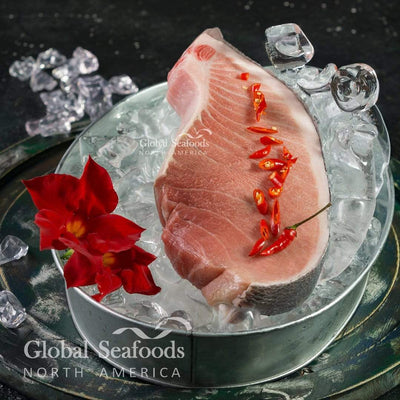
Now that you know what makes bluefin tuna so extraordinary, experience it for yourself. Global Seafoods offers premium sushi-grade Bluefin Tuna Belly (Otoro) and dry-aged bluefin toro sourced from responsibly managed Atlantic fisheries — delivered fresh to your door.
Also in News

Halibut Nutrition Facts: Everything You Need to Know

Crab vs. Lobster: Which is Healthier?

The Health Benefits of Ikura: What You Need to Know
Shop Now
Main
