
The Fascinating History of Osetra Caviar: From Russia to a Global Delicacy

The History of Osetra Caviar
Osetra caviar’s path from the Caspian and Black Sea river systems to the menus of three-star restaurants on four continents is a story about three distinct forces: geography that created an extraordinary abundance of wild sturgeon, a Russian aristocratic tradition that codified caviar as a luxury food and export commodity, and then a conservation crisis that nearly ended wild production entirely and forced the creation of a global aquaculture industry from scratch. Understanding that sequence explains both why Osetra commands the prices it does today and why the farmed product has become genuinely comparable in quality to the wild caviar that drove the original demand.
For more insights into caviar sourcing and serving, visit the Global Seafoods YouTube channel.
What Is Osetra Caviar?
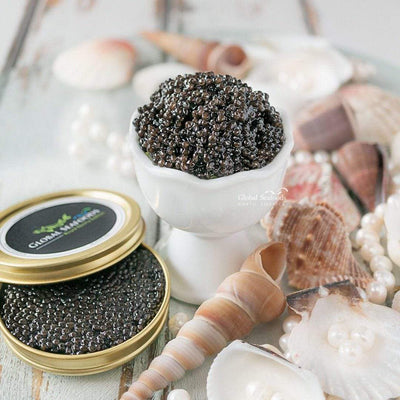
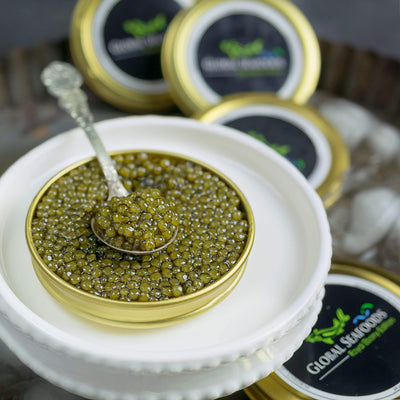
Osetra caviar is produced from the roe of Acipenser gueldenstaedtii, the Russian sturgeon, native to the Caspian Sea basin and historically abundant in the Volga, Ural, and Kura river systems. The eggs are medium-to-large, ranging from olive-brown to golden amber in color, with a flavor arc built on clean brine at the front, a nutty hazelnut mid-palate, and a long buttery finish. That flavor arc — layered and developing over 15–20 seconds after the pearl pops — is the defining characteristic that distinguishes Osetra from Sevruga (more immediately intense, saltier, shorter finish) and from Beluga (richer, creamier, less complex, shorter arc).
The variation in Osetra flavor across individual tins reflects the sturgeon’s diet, water temperature, and the specific river system or farm environment. Wild Osetra from the Caspian historically showed the widest range — from intensely marine to almost sweet, depending on the sturgeon’s feeding grounds. Farmed Osetra produces a more consistent profile because feed and water conditions are controlled, but the best farmed producers maintain enough variation in diet to preserve the hazelnut complexity that defines premium Osetra.
To experience the flavor arc firsthand, browse Global Seafoods’ Osetra caviar, alongside Beluga Caviar and Siberian Sturgeon Caviar for comparison.
Early Beginnings: Caviar in Ancient Russia
Sturgeon were abundant in the Caspian and Volga river systems for millennia, and archaeological evidence suggests that the eggs were consumed by communities along these waterways from at least the 10th century. The earliest documented Russian references to caviar as a specific food appear in the 13th century, when Mongolian-influenced trade routes along the Volga created commercial movement of preserved fish products — including salt-cured roe — between the Caspian coast and the Russian interior.
By the 15th and 16th centuries, caviar had become formalized as an aristocratic food in the Russian court. Ivan the Terrible (r. 1547–1584) is documented as a significant consumer of sturgeon products, and Muscovite court records from this period list caviar among the provisions for major feasts and diplomatic occasions. The Russian Orthodox Church’s classification of fish roe as a permitted food during Lent and other fasting periods — fish being distinct from meat under Orthodox dietary rules — created a broader cultural acceptance of caviar that extended well beyond the aristocracy. This religious dimension is significant: it meant that caviar was consumed by a much wider population during fasting seasons than the price alone would suggest, and that cultural familiarity with the product was distributed across social classes even when the finest grades were accessible only to the elite.
Peter the Great (r. 1682–1725) accelerated the commercialization of Russian caviar production through his modernization of trade infrastructure along the Volga and Caspian. His founding of St. Petersburg created a new western-facing port city with direct connections to European trade networks, and Russian caviar — including Osetra — began reaching European markets through this route during the early 18th century.
The Rise of Russian Caviar Exports
The 19th century was the pivotal period for Osetra caviar’s international reputation. Russian exports to Western Europe grew substantially from the 1820s onward, driven by a combination of improved preservation techniques (particularly the development of more consistent malossol processing, which produced a milder, less aggressively salted product than earlier export grades) and the expansion of European luxury food trade through Paris.
European nobility and haute cuisine. French chefs of the Second Empire and Third Republic period encountered Russian caviar through diplomatic contacts and Russian aristocratic exile communities in Paris, and began incorporating it into the emerging canon of French haute cuisine. By the 1890s, service of caviar on blinis with crème fraîche — the Russian aristocratic format — had been adopted into formal French table service and was being served in the grand restaurants of Paris, Vienna, and London. Osetra, with its more complex flavor profile compared to Sevruga, was particularly favored in French high cuisine contexts where layered flavor and restraint were valued over immediate intensity.
American market development. Caviar reached the United States in two waves. The first, in the late 19th century, was primarily domestic American sturgeon caviar — the Delaware and Hudson Rivers had substantial sturgeon populations, and American caviar was briefly abundant and cheap (it was served free in saloons, which drove heavy fishing and the collapse of the domestic American sturgeon fishery by the early 1900s). The second wave, from the early 20th century onward, was imported Russian caviar — including Osetra — which entered the American luxury market through specialty food importers and quickly established itself in fine dining and hotel service. By mid-century, Osetra caviar was standard in the premium New York and Los Angeles restaurant markets.
The overfishing crisis. The combination of Soviet-era industrial fishing of the Caspian sturgeon population and post-Soviet collapse of regulatory infrastructure produced a severe decline in wild Caspian sturgeon stocks through the 1970s–1990s. By the 1990s, wild Beluga, Osetra, and Sevruga populations in the Caspian were assessed at a fraction of their mid-century levels. CITES listing of Caspian sturgeon species followed, with Appendix II controls on international trade from 1998 and a near-total ban on wild Beluga caviar importation to the United States from 2005. Wild Osetra caviar remained available in limited quantities through licensed channels, but the commercial reality by the early 2000s was that the wild Caspian caviar trade as it had existed for a century was effectively over. For sustainably farmed alternatives, see California White Sturgeon Caviar and Kaluga Caviar.
Modern Osetra Caviar: Aquaculture and the Quality Question
The collapse of wild Caspian production forced the development of commercial sturgeon aquaculture from roughly the 1990s onward. The initial challenge was biological: Acipenser gueldenstaedtii takes 7–12 years to reach sexual maturity in farmed conditions, meaning the capital investment in a sturgeon farm precedes any revenue by nearly a decade. This economics of sturgeon farming — long time horizons, high capital costs, no shortcuts in the biological cycle — is why entry-level farmed caviar tends to be compromised in quality: producers under financial pressure harvest before the sturgeon have reached optimal maturity. Premium farmed Osetra comes from operations that can absorb that full time horizon.
The quality comparison between farmed and wild Osetra is nuanced. In controlled farm conditions, water temperature, oxygen levels, and diet can be managed to produce very consistent caviar with a reliable flavor profile. The best farmed Osetra — from established operations in France, Italy, Israel, China, and the United States (California and Idaho) — is genuinely comparable in quality to premium wild Osetra of the late Caspian era, and in some respects more consistent because the production variables are controlled rather than dependent on the specific feeding grounds of individual fish. The hazelnut mid-palate that defines premium Osetra can be maintained or even enhanced through careful feed management. The main quality differentiator in the farmed market is not wild vs. farmed but rather the age and maturity of the sturgeon at harvest, the precision of the malossol processing, and the cold-chain integrity from tin to consumer.
Osetra caviar remains a luxury market standard in fine dining globally. Its position relative to Beluga (richer, less complex, higher prestige by historical convention) and Sevruga (more intense, lower price point, smaller pearl) has been stable — Osetra is the middle tier by price but arguably the most interesting tier by flavor complexity, which is why it is frequently the preferred choice of people who have tasted all three.
How to Identify High-Quality Osetra Caviar
Pearl firmness: The membrane should resist slightly, then pop cleanly. Soft or mushy pearls indicate temperature compromise or over-salting — either storage failure or a processing defect.
Color consistency: Premium Osetra should show consistent color within the tin — deep olive-brown to golden amber. Significant color variation within a single tin may indicate mixed-grade blending or uneven curing.
Aroma: Clean, oceanic, faintly nutty. Any sour, ammonia, or strongly fishy note indicates age or temperature compromise.
Flavor arc: The sequence matters — brine at the front, hazelnut mid-palate developing 3–5 seconds after the pop, long buttery finish lasting 15–20 seconds. Flat or one-dimensional flavor (only salt, or only mild fishiness with no development) indicates low maturity at harvest, over-salting, or temperature damage.
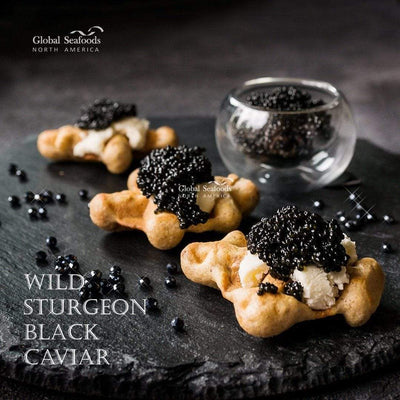
Provenance: CITES registration for the farm, clear country of origin, and a traceable producer. Reputable online sellers provide this documentation on request. For quality you can verify, explore Wild Sturgeon Black Caviar and Sevruga Sturgeon Caviar.
More Caviar Guides
- Osetra Caviar: A Complete Guide to Flavor, Sourcing, and Serving — grades, origins, and pairings.
- How to Identify High-Quality Osetra Caviar — pearl firmness, color grade, flavor arc, and traceability in depth.
- Osetra Caviar and Blinis: A Classic Russian Appetizer for Fine Dining — the historical serving format with a full buckwheat blini recipe.
- Osetra Caviar Production: A Journey from Farm to Table — the modern aquaculture process in detail.
- Black Caviar: The Ultimate Guide to the World’s Most Luxurious Delicacy — overview of all black caviar varieties, grading, and tasting notes.
Frequently Asked Questions About Osetra Caviar’s History
What sets Osetra caviar apart from other types of caviar?
The flavor arc: brine at the front, hazelnut mid-palate developing 3–5 seconds after the pearl pops, long buttery finish lasting 15–20 seconds. Osetra’s complexity is greater than Sevruga (more immediately intense, shorter arc) and more interesting than Beluga (richer and creamier but less layered). The variation in Osetra across individual fish and farms also makes it the most nuanced of the three major varieties — which is why it tends to be the preferred variety of people who have tasted all three.
How has the shift to sustainable farming impacted Osetra caviar quality?
For premium producers, favorably. Controlled water temperature, oxygen levels, and diet produce a consistent flavor profile that is reliably comparable to the best wild Caspian Osetra of the pre-crisis era. The main quality differentiator in the farmed market is sturgeon age at harvest (younger fish produce simpler, less complex roe), malossol processing precision, and cold-chain integrity — not wild vs. farmed as a category.
What’s the best way to enjoy Osetra caviar?
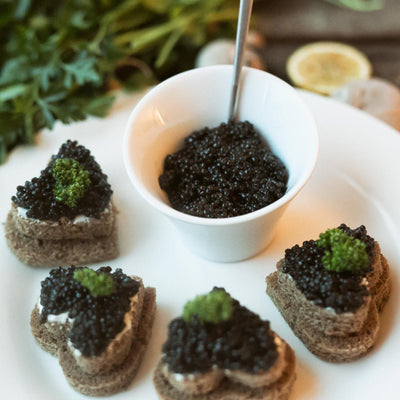
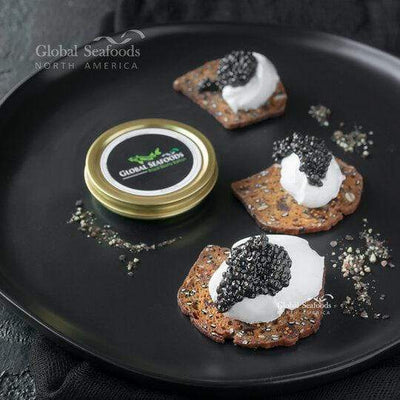
Simply, on its own or with minimal accompaniment — buckwheat blinis, crème fraîche, mother-of-pearl spoon. The full serving protocol and rationale for each element is in our blinis and caviar guide. For beverage pairing: Blanc de Blancs Champagne (low dosage, mineral, clean acid) or chilled vodka (cleanses the palate between bites without adding flavor that competes with the caviar).
Can I still find wild-caught Osetra caviar?
In very limited quantities through licensed channels — CITES Appendix II controls international trade and requires documentation at every transfer point. Most Osetra on the market is farmed. Authentic wild Osetra from a traceable source will be documented with CITES permits and is priced substantially above farmed product. Claims of wild Osetra without this documentation are unverifiable and may be inaccurate.
Where can I buy authentic, high-quality Osetra caviar?
Our Osetra caviar and full caviar collection — sustainably sourced, CITES-registered where applicable, with insulated cold-chain shipping on every order.

Related Products


Also in News

Snail Caviar: How White Escargot Caviar Is Farmed, Harvested and Made

The Dark Years of Pacific Salmon: A 20-Year Outlook for Alaska, Russia, and the Red Caviar Market

King Crab Legs Delivery: Is It Worth It? Exploring the Benefits and Best Options
Shop Now
Main
