
Chum Ikura – A Deep Dive into Quality, Freshness, and What Sets It Apart

Chum Ikura: What Separates Premium Quality from Substandard Product
Chum Ikura — salmon roe from Chum (Keta) salmon (Oncorhynchus keta), salt-cured and sold as individual free-flowing beads — is one of the most widely produced and consumed salmon roes globally, particularly in Japanese cuisine where it is the dominant species used for ikura. When produced well, it has a mild-sweet oceanic flavor, a firm distinctive pop, and vibrant orange-red color. When produced poorly, it has a flat or overly salty flavor, soft or broken beads, and a shorter-than-expected shelf life.
This article covers the three production variables that most determine whether a batch of Chum Ikura is premium or substandard, and how to identify quality at the point of purchase.
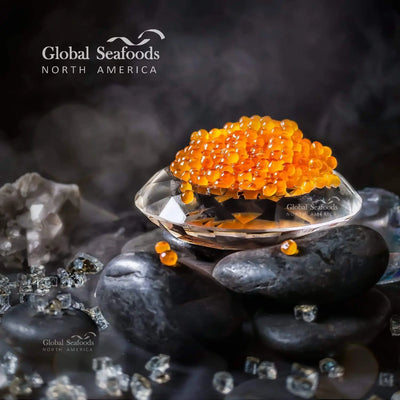
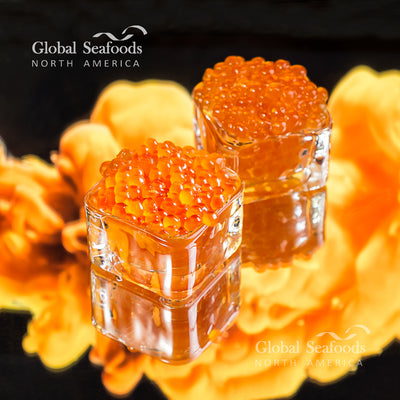
Product: Chum Salmon Caviar at Global Seafoods.
The three production variables that determine Chum Ikura quality
1. Egg freshness at time of processing
Freshness is the most important single variable in ikura production. Salmon eggs begin to change immediately after the fish is harvested: the egg membrane (chorion) begins to harden slightly, then progressively soften as post-mortem enzymatic processes proceed. The window for optimal processing — maximum membrane integrity, cleanest flavor, highest-quality roe — is immediately after harvest, ideally within hours.
What happens with delay under refrigeration:
- Membrane softening: The primary effect of delay is progressive softening of the egg membrane. Eggs that would have produced a firm, clean pop at harvest produce a softer, less defined pop after 24–48 hours even under refrigeration. This is the most common cause of "soft" ikura.
- Flavor changes: As the fish sits post-harvest, off-flavor compounds develop. These range from a slightly fishy oxidation note (lipid oxidation) to a mild ammonia note (bacterial activity) — depending on temperature management. A clean, just-processed batch of ikura should smell purely oceanic with no other notes.
- Omega-3 content: Omega-3 fatty acids (EPA and DHA) are structural lipids in the egg membrane. They do not meaningfully degrade over the processing delays of hours to 1–2 days that are typical of fish processing. The nutritional impact of reasonable processing delays is minor. What degrades first is texture and flavor cleanliness, not the omega-3 content.
2. The salt-curing process
The brine curing process serves two functions: preservation (salt inhibits bacterial growth) and flavor development (salt enhances the natural flavor of the roe and firms the membrane slightly through osmotic action). Getting the brine right requires controlling salt concentration, brine temperature, immersion time, and brine uniformity.
- Over-salting: Excessive salt concentration or too-long immersion time produces ikura where the first flavor impression is overwhelming brine with no natural sweetness detectable. The membrane may also become overly firm and rubbery rather than firm and poppable. Over-salted ikura is used to compensate for lower-quality raw material — more salt masks off-flavors from delayed processing.
- Under-salting: Insufficient salt level or too-short curing time produces ikura with inadequate preservation (shorter shelf life, faster bacterial growth) and underdeveloped flavor. The natural sweetness is present but the balancing brine note is absent; the result tastes flat and overly fresh in an unpleasant way.
- Inconsistent brining: Uneven salt distribution — from inadequate mixing, too much roe in the brine volume, or brine that is not fully dissolved — produces a batch where some eggs are overcured (salty) and others are undercured (flat). This is detectable in a tasting: successive eggs from the same batch taste noticeably different from one another.
3. Cleaning and skein separation
Before curing, the roe must be separated from the skein (the connective membrane holding the egg mass together) and rinsed to remove blood, membrane fragments, and surface contaminants. Thorough cleaning produces ikura with clear brine, clean flavor, and no off-notes from residual membrane or blood. Poor cleaning produces:
- Residual blood: Blood in the batch imparts a metallic, bitter note to the flavor profile and turns the brine cloudy and reddish-brown.
- Membrane fragments: Connective tissue fragments from incomplete skein separation impart a slightly rubbery, fibrous mouthfeel and can harbor bacteria.
- Cloudy brine: Cloudiness in the jar (when it is not caused by broken eggs) often indicates inadequate rinsing. Clear or very lightly colored brine is the standard for well-cleaned ikura.
How to identify high-quality Chum Ikura at purchase
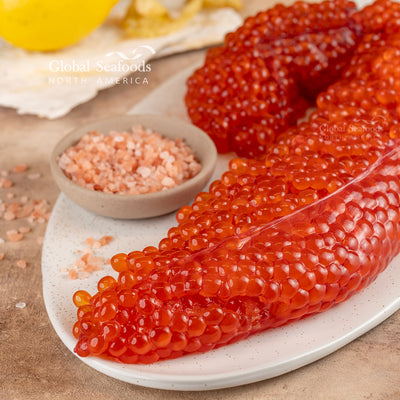
Visual (jar closed): Brine should be clear or only very lightly orange-tinted. Cloudy brine = inadequate cleaning or broken eggs present. Beads should be uniform in size and color — vivid, saturated orange-red with high gloss. Pale, dull, or brownish coloration indicates roe harvested at the wrong maturity stage or improperly stored.
Visual (jar open): No broken or deflated eggs visible on the surface. All beads same diameter. No membrane fragments or fibrous material.
Smell: Clean, purely oceanic. No ammonia (bacterial degradation). No oxidized-fish note (lipid oxidation from cold chain failure or age). Either disqualifies the product.
Taste: Clean brininess first, then natural sweetness within 2–3 seconds. Membrane pops clearly. If the first impression is overwhelming salt with no sweetness: over-cured or low-quality raw material. If no pop: late-season roe or cold chain failure. If metallic or bitter: inadequate cleaning (residual blood or membrane).
Storage before purchase: Should have been kept at 28–32°F continuously. Signs of thaw-refreeze: slightly wrinkled beads, cloudy brine, soft membrane that doesn’t pop.
After opening: Consume within 3–4 days, tightly sealed at 28–32°F. Do not freeze after opening.
Also: Pink Salmon Caviar • Coho Salmon Caviar • Rainbow Trout Pearls • Bloody Shiraz Infused Caviar.
Videos: Global Seafoods YouTube Channel.
Related Products


Also in Video

Salmon Tender Monroe: Inside a Suquamish Tribal Vessel Unloading Wild Salmon
The Salmon Tender Monroe is a Suquamish Nation vessel operating in Puget Sound — collecting wild salmon from tribal fishing boats and delivering them to shore. This is the story of a living treaty right, a working vessel, and the wild salmon that have sustained the Suquamish people for thousands of years.

Vietnam Fisherman: Small Boat Leaving Lang Co Bay for the Night Catch
As the sun drops behind the Hải Vân Pass, a lone Vietnamese fisherman pushes off from Lang Co Bay and heads into the darkness of the South China Sea. This is the story of a single boat, a single night, and the ancient rhythm of fishing that still feeds communities across central Vietnam.

Lang Co, Vietnam: Inside the Coastal Fishing Life That Feeds a Nation
Lang Co is one of Vietnam’s most beautiful and storied fishing communities — a narrow strip of land between a turquoise lagoon and the South China Sea. This is the story of the fishermen, their boats, and the wild seafood traditions that have sustained this village for generations.
Shop Now
Main
