
Chum Salmon Red Caviar: A Luxurious and Sustainable Ocean Delicacy

Chum Salmon Red Caviar: Flavor, Characteristics, and How to Enjoy It
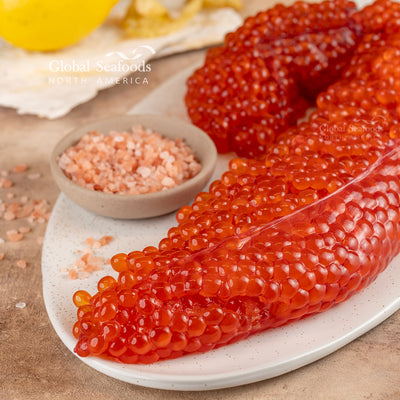
Among the Pacific salmon roes, chum salmon caviar — the salt-cured roe of Oncorhynchus keta — occupies a distinctive and highly regarded position. It produces the largest eggs of any Pacific salmon species (4–6mm), with the most delicate membrane of the group, a mild buttery sweetness, and the vivid orange color that defines the classic Japanese ikura. For anyone new to red caviar, chum roe is the benchmark: its approachable flavor and satisfying soft burst make it the most widely used salmon roe in Japanese cuisine and the most recognizable Pacific salmon caviar worldwide.
Shop premium chum salmon caviar: Chum Salmon Caviar Soft Shell | Full Red Caviar Collection.
What Is Chum Salmon Caviar?
Chum salmon (Oncorhynchus keta) is one of the most widely distributed Pacific salmon species, found throughout the North Pacific from Alaska to Siberia. It is the second-largest Pacific salmon species by weight and has one of the most abundant and well-managed wild populations. Its roe is harvested primarily from wild Alaskan fisheries during the late summer to early fall spawning run.
Key physical and flavor characteristics:
- Egg size: 4–6mm — the largest of the Pacific salmon roes, and among the most visually striking.
- Color: Bright to deep orange, occasionally amber; vivid and consistent within a well-graded batch.
- Membrane: The most delicate of the Pacific salmon roes — thin, yielding, and producing a soft, gentle burst rather than a firm pop. This is the defining physical characteristic of chum roe and the primary reason it became the standard for Japanese ikura.
- Flavor: Mild, buttery, and subtly sweet with gentle oceanic brininess. The least assertive of the major Pacific salmon roes — it allows the natural ocean sweetness to come forward without the more intense saltiness of sockeye or the slightly tangy quality of coho.
How Chum Salmon Caviar Is Produced
Harvest. Wild chum salmon are harvested from Alaska’s cold Pacific waters during the spawning season under Alaska Department of Fish and Game catch quotas and escapement goals. Chum salmon populations are among the most abundant of the Pacific salmon species and are sustainably managed, with many Alaska chum fisheries holding Marine Stewardship Council (MSC) certification. The roe skeins are removed from female fish immediately after harvest and kept at near-freezing temperatures to halt deterioration.
Cleaning and malossol curing. The roe is separated from the skein membrane using fine mesh screens, rinsed under cold water, then cured using the malossol process: approximately 3–5% salt by weight. At this salt level, the natural flavor of the roe dominates and the membrane remains pliant. Higher salt concentrations (used for lower-grade product) produce a firmer, saltier egg that loses the characteristic soft burst that defines premium chum caviar.
Grading and packaging. Cured roe is inspected for egg integrity (no burst or broken eggs), color uniformity, and aroma. The soft-shell grade — Chum Salmon Caviar Soft Shell — refers specifically to roe harvested at the optimal point in the salmon’s development, when the egg membrane is at its thinnest and most yielding. Premium product is sealed in airtight, non-reactive containers and immediately refrigerated or vacuum-sealed.
Chum vs. Other Pacific Salmon Roes
Understanding where chum sits relative to other roes helps match the right product to the right use:
- Chum (keta) — largest grain, softest membrane, mildest flavor. The ikura benchmark; ideal for raw presentations where the soft burst and visual impact are primary. The most approachable entry point for those new to salmon roe.
- Coho (silver) — medium grain (3–4mm), moderate membrane, balanced flavor. More flavor complexity than chum; slightly more briny and tangy. Excellent for composed dishes and sushi where the caviar should complement without overwhelming.
- Sockeye (red) — smallest grain (3–3.5mm), firmest membrane, most intense flavor. The most assertive of the three; deepest red color; preferred by those who want the most pronounced oceanic character.
- Pink (humpy) — small grain, most delicate, lowest price. Most subtle flavor; best value entry point; well suited to cooked applications.
Culinary Applications
Chum salmon caviar’s large grain size and soft burst make it particularly well suited to presentations where visual impact and texture are the primary eating experience:
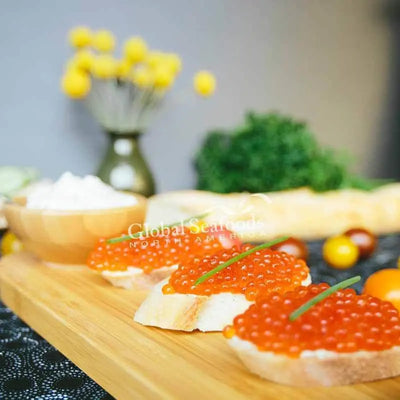
Classic raw service: Blinis with crème fraîche — the large, vivid orange eggs are visually dramatic against white crème fraîche and the soft burst pairs perfectly with the slight tang of the dairy. Toast points with lightly salted butter. Chilled in the jar on crushed ice, served with mother-of-pearl spoons — never metal, which reacts with the roe’s oils and imparts a metallic off-flavor.
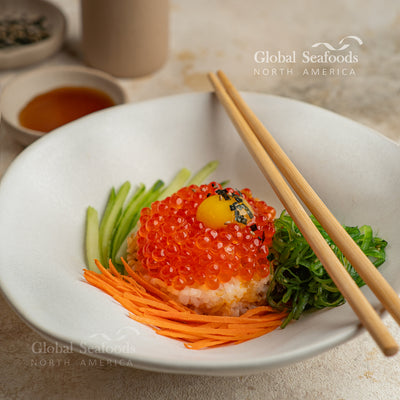
Japanese cuisine (ikura): Chum roe is the overwhelmingly dominant species used for Japanese ikura. Served over steamed short-grain rice (ikura don), as a gunkan-maki topping, or in hand rolls. The large grain size and soft burst create the most satisfying textural contrast with warm rice.
Contemporary presentations: Deviled eggs garnished with chum caviar — the large eggs sit visually prominently and the soft burst contrasts the dense yolk filling. Potato chips or latkes with crème fraîche. Cucumber rounds with cream cheese. Seafood platters combining chum caviar with smoked salmon, oysters, and shrimp.
Cooked applications: Add off heat only — sustained heat above approximately 120°F bursts the membranes and destroys the burst texture. Finish pasta, risotto, or scrambled eggs by removing from heat, plating, then spooning caviar over. The residual warmth of the dish is sufficient to slightly warm the roe without cooking it.
For preparation techniques and serving ideas, visit the Global Seafoods YouTube Channel.
Nutritional Profile
Per 30g serving (a generous topping portion):
- Omega-3 fatty acids (EPA + DHA): Approximately 600–900mg of combined long-chain marine omega-3s. EPA supports cardiovascular and anti-inflammatory pathways; DHA is essential for neurological function and retinal health. See the NIH Office of Dietary Supplements omega-3 fact sheet for evidence-based guidance on marine omega-3 intake.
- Complete protein: All essential amino acids; supports muscle maintenance, tissue repair, and enzyme synthesis.
- Vitamin B12: One of the richest dietary sources; essential for red blood cell formation, neurological function, and DNA synthesis.
- Vitamin D: One of the few non-fortified foods with meaningful vitamin D content; supports calcium absorption, bone metabolism, and immune regulation.
- Selenium: Cofactor for glutathione peroxidase (primary intracellular antioxidant); supports thyroid hormone metabolism.
- Caloric density: Approximately 75–85 kcal per 30g serving — moderate at typical serving sizes, allowing regular consumption without significant caloric impact.
Sustainability
Chum salmon are among the most abundant of the Pacific salmon species, with wide distribution across Alaska, British Columbia, and Siberia. Alaska’s chum salmon fisheries are managed under the state’s constitutionally mandated sustained yield principles, with annual escapement goals and harvest limits set by the Alaska Department of Fish and Game. Many Alaska chum fisheries hold MSC (Marine Stewardship Council) certification, providing independent third-party verification of sustainable harvest practices. When purchasing, look for products that identify Alaska wild-caught origin and, ideally, specific fishery or regional information.
Explore more sustainably sourced roe options: Pink Salmon Caviar | Golden Pearls Brook Trout Caviar | Full Red Caviar Collection.
Frequently Asked Questions
What makes chum salmon caviar unique among Pacific salmon roes?
Chum salmon produces the largest eggs of any Pacific salmon species (4–6mm) with the most delicate, thin membrane — giving a soft, gentle burst rather than a firm pop. Its flavor is the mildest and most buttery of the Pacific salmon roes, making it the most approachable for first-time red caviar tasters and the standard for Japanese ikura. The large grain size also makes it the most visually striking for presentation.
How does chum salmon caviar compare to other salmon roes?
Chum has the largest grain (4–6mm), softest membrane, and mildest, most buttery flavor. Coho is medium-grained (3–4mm) with a more complex, slightly tangy flavor. Sockeye is the smallest-grained (3–3.5mm) with the most intense, assertive brininess and firmest membrane. Pink salmon roe is the smallest and most subtle, and the most affordable. All are nutritionally comparable in omega-3 and protein content.
What does chum salmon caviar taste like?
Mild, buttery, and subtly sweet with gentle oceanic brininess. It is the least assertive of the major Pacific salmon roes — the natural ocean sweetness comes forward without the pronounced saltiness of sockeye or the tangy quality of coho. The thin egg membrane produces a soft, yielding burst (not crunchy) that releases the flavor gently. It is frequently described as the most accessible salmon roe for those unfamiliar with caviar.
How should chum salmon caviar be stored?
Unopened: refrigerate at 32–38°F (0–3°C) in the coldest zone of the refrigerator. Consume by the best-by date (typically 2–3 weeks for fresh malossol product). After opening: transfer to an airtight non-metallic container, press plastic wrap against the surface to minimize air contact, and consume within 2–3 days. Never use metal utensils or metal containers — metal reacts with the roe’s oils and produces a metallic off-flavor. Use mother-of-pearl, horn, or food-safe plastic spoons.
What sets red caviar apart from black (sturgeon) caviar?
Red caviar comes from Pacific salmon (Oncorhynchus species); black caviar comes from sturgeon (Acipenser species). Sturgeon caviar is smaller-grained (1–3mm), more intensely mineral and nutty in flavor, and significantly more expensive due to source fish rarity and lengthy aquaculture cycles (7–10+ years to first harvest). Red caviar is larger-grained, more oceanic and sweet in flavor, and substantially more affordable while still offering the signature burst-texture eating experience and a strong nutritional profile.
Is chum salmon caviar sustainable?
Yes — chum salmon are among the most abundant Pacific salmon species, and Alaska’s chum fisheries are managed under constitutionally mandated sustained yield principles with annual escapement goals and harvest limits. Many hold MSC (Marine Stewardship Council) certification. Look for products identifying Alaska wild-caught origin and, ideally, fishery or regional information. Global Seafoods’ Chum Salmon Caviar is sourced from Alaska’s sustainably managed wild fisheries.
Related Products


Also in Video

Salmon Tender Monroe: Inside a Suquamish Tribal Vessel Unloading Wild Salmon
The Salmon Tender Monroe is a Suquamish Nation vessel operating in Puget Sound — collecting wild salmon from tribal fishing boats and delivering them to shore. This is the story of a living treaty right, a working vessel, and the wild salmon that have sustained the Suquamish people for thousands of years.

Vietnam Fisherman: Small Boat Leaving Lang Co Bay for the Night Catch
As the sun drops behind the Hải Vân Pass, a lone Vietnamese fisherman pushes off from Lang Co Bay and heads into the darkness of the South China Sea. This is the story of a single boat, a single night, and the ancient rhythm of fishing that still feeds communities across central Vietnam.

Lang Co, Vietnam: Inside the Coastal Fishing Life That Feeds a Nation
Lang Co is one of Vietnam’s most beautiful and storied fishing communities — a narrow strip of land between a turquoise lagoon and the South China Sea. This is the story of the fishermen, their boats, and the wild seafood traditions that have sustained this village for generations.
Shop Now
Main
