
Discover the Rich Delicacy of Red Caviar: Origins, Benefits, and Serving Suggestions

Red Caviar: Origins, Nutrition, and How to Serve It
Red caviar — the cured roe of salmon and trout — is one of the most widely consumed forms of caviar in the world, and one of the most misunderstood. It is often treated as a lesser alternative to black sturgeon caviar, but red caviar has its own distinct flavor profile, cultural history, and culinary applications that make it a genuinely different product rather than a substitute. This guide covers the origins of red caviar, its nutritional profile, the key differences between red and black caviar, and how to serve it correctly.
🔗 All Red Caviar and Salmon Roe at Global Seafoods
Origins and Cultural History
Russia: Red Caviar as a Staple, Not a Luxury
In Russia, red caviar (krasnaya ikra) has been consumed for centuries — not as an aristocratic luxury, but as a widely available, affordable food for ordinary people. Pacific salmon were abundant in the rivers of Siberia and the Russian Far East, and salmon roe was a practical, protein-rich food that could be preserved with salt for transport and storage. By the 20th century, red caviar had become a staple of Russian cuisine — served on buttered bread (buterbrody s ikroy) at celebrations, holidays, and everyday meals. The association of red caviar with luxury in Western markets is largely a function of import costs and marketing rather than its status in its country of origin.
Japan: Ikura as a Sushi Ingredient
In Japan, salmon roe is known as ikura (from the Russian word "ikra," meaning fish eggs — a linguistic trace of the historical trade relationship between Japan and Russia). Ikura is a standard sushi ingredient — served as nigiri (on seasoned rice, wrapped with a strip of nori) or as a topping for chirashi bowls and donburi. The Japanese preference is for large-egg, malossol-cured chum salmon roe (Hokkaido ikura is considered the benchmark), and the quality standards for ikura in Japan are among the most demanding in the world.
Pacific Northwest: Indigenous and Commercial Harvesting
Pacific salmon roe has been harvested and consumed by Indigenous peoples of the Pacific Northwest for thousands of years. Commercial salmon roe processing in the US and Canada developed in the late 19th century, initially driven by export demand from Japan. Today, the US (primarily Alaska) and Canada are among the world's largest producers of salmon roe, with the majority of premium product exported to Japan and Russia.
Red Caviar vs. Black Caviar: Key Differences
- Source: red caviar comes from salmon and trout (family Salmonidae); black caviar comes from sturgeon (family Acipenseridae)
- Egg size: red caviar has larger eggs (3–7mm depending on species) than most black caviar (1–3.5mm for most sturgeon species); the larger eggs produce a more pronounced pop
- Flavor: red caviar has a more assertive, briny, oceanic flavor with a pronounced sweetness (from glycine) and a clean finish; black caviar (particularly Beluga and Ossetra) has a more delicate, buttery, nutty flavor with a longer, more complex finish; neither is objectively better — they are genuinely different flavor experiences
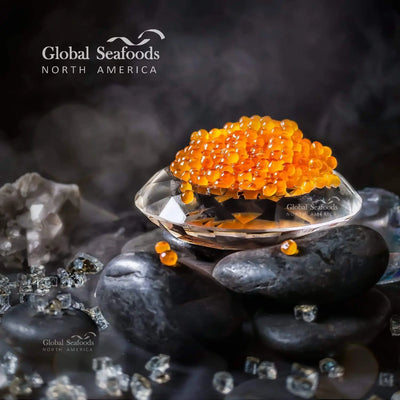
- Color: red caviar ranges from bright orange to deep red depending on the species; black caviar ranges from dark gray to black
- Price: red caviar is significantly less expensive than premium black caviar; the price difference reflects the relative scarcity of sturgeon (which take 10–15 years to reach reproductive maturity) versus salmon (which reach maturity in 2–5 years)
- Availability: red caviar is widely available year-round; premium black caviar is more limited in availability and is typically purchased from specialty suppliers
Nutritional Profile
Per tablespoon (approximately 16g) of salmon roe:
- Calories: approximately 40–45 kcal
- Protein: approximately 4g — complete protein with all essential amino acids
- Fat: approximately 2–3g, of which a significant proportion is omega-3 fatty acids (EPA and DHA)
- Omega-3 fatty acids: salmon roe is one of the most concentrated dietary sources of omega-3s per calorie; the American Heart Association recommends omega-3-rich seafood as part of a heart-healthy diet
- Vitamins: B12 (energy production, nerve function), D (bone health, immune function), A (vision, immune health), E (antioxidant)
- Minerals: selenium (antioxidant, thyroid function), zinc (immune function), iron
Red caviar is nutrient-dense relative to its calorie content — a tablespoon provides meaningful amounts of omega-3s, complete protein, and several vitamins and minerals. The salt content is significant (approximately 400–600mg sodium per tablespoon for malossol roe) and should be considered by those monitoring sodium intake.
How to Serve Red Caviar
The serving principles for red caviar are the same as for all roe: serve cold, add last, use non-metallic utensils, and do not apply acid directly to the roe. The four most common serving formats:
Blini with Crème Fraîche
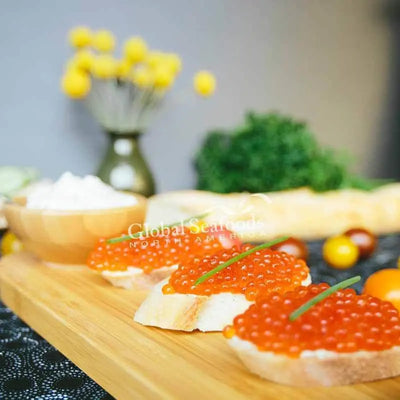
The classic Russian presentation. Buckwheat blini topped with crème fraîche and a spoonful of Chum Salmon Caviar; garnish with fresh dill. For the full technique, see the salmon roe appetizers guide.
Canapés and Crackers
Cream cheese or crème fraîche on water crackers or toasted baguette, topped with Coho Salmon Caviar or Pink Salmon Caviar. Assemble immediately before serving — crackers become soggy within 15–20 minutes.
Sushi (Ikura Nigiri and Donburi)
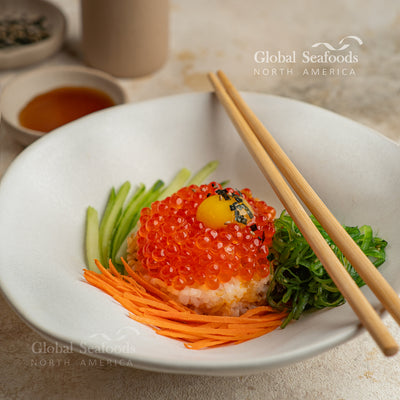
Ikura nigiri: seasoned sushi rice topped with salmon roe, wrapped with a strip of nori. Ikura don: seasoned rice in a bowl topped with a generous serving of roe. Use Chum Salmon Caviar for the most authentic ikura experience. For the full recipe, see the sushi bowl guide.
Pasta
Add red caviar as a topping or fold it into a light butter emulsion pasta immediately before serving — off heat, after the pasta has cooled for 60–90 seconds. Do not use heavy cream sauces, which mask the roe's flavor. Use Chum or Coho Salmon Caviar for pasta. For the full pairing guide, see the salmon roe pasta guide.
Red Caviar Products at Global Seafoods
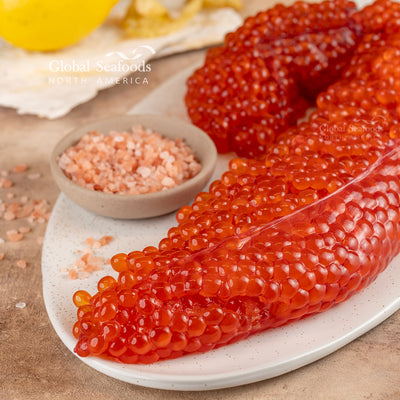
- 🔗 Chum Salmon Caviar (Soft Shell) — large eggs, mild and clean; the benchmark for premium ikura
- 🔗 Coho Salmon Caviar — richer and more complex flavor; medium-large eggs
- 🔗 Pink Salmon Caviar — smaller eggs, mild flavor; most affordable; excellent for everyday use and cooking
- 🔗 Trout Red Caviar — smaller eggs, bright orange, mild and slightly sweet
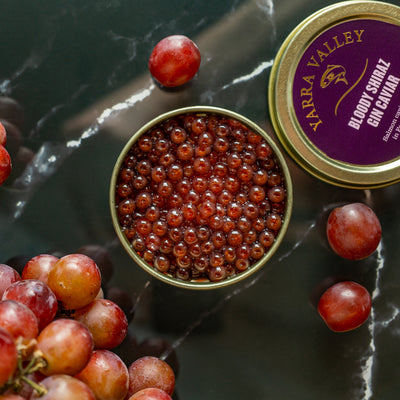
- 🔗 Bloody Shiraz Infused Caviar — wine-infused specialty; fruity complexity; pairs with earthy flavors
- 🔗 Rainbow Trout Pearls — small, delicate pearls; mild flavor; visually striking
🎥 Watch red caviar serving and tasting guides on the Global Seafoods YouTube Channel
FAQs: Red Caviar
What is the difference between red caviar and black caviar, and is one better than the other?
Red caviar (salmon and trout roe) and black caviar (sturgeon roe) are genuinely different products with different flavor profiles, not a hierarchy where one is objectively better. Red caviar: larger eggs (3–7mm), more assertive briny and oceanic flavor, pronounced sweetness, clean finish; significantly less expensive; widely available. Black caviar: smaller eggs (1–3.5mm for most species), more delicate and buttery flavor, longer and more complex finish; significantly more expensive due to the long production time of sturgeon (10–15 years to reproductive maturity). The choice between them depends on flavor preference and budget, not quality ranking. For someone new to caviar, red caviar is the more accessible starting point — the flavor is vivid and immediately recognizable; black caviar rewards more experienced tasters who appreciate its subtlety and complexity.
How do I know which red caviar variety to buy, and what is the practical difference between chum, coho, and pink salmon roe?
The practical differences: Chum salmon roe — largest eggs (5–7mm), mildest and cleanest flavor, most pronounced pop, the benchmark for premium ikura in Japanese cuisine; best for raw presentations where the roe is the centerpiece (blini, nigiri, sashimi). Coho salmon roe — medium-large eggs (4–6mm), richer and more complex flavor than chum, more assertive oceanic quality; excellent for raw presentations and pasta. Pink salmon roe — smallest eggs (3–4mm), softest texture, mildest flavor, most affordable; best for cooking applications and preparations where the roe is one component among many. For a first purchase: buy chum for a tasting or special occasion presentation; buy pink for everyday cooking use. For a detailed comparison, see the salmon roe grades guide.
How long does red caviar last, and what are the signs that it has gone bad?
Unopened fresh malossol red caviar: 4–6 weeks refrigerated from the pack date. Opened red caviar: 3–5 days refrigerated in an airtight container. Pasteurized red caviar: 3–6 months unopened; 3–5 days after opening. Signs of spoilage: ammonia or sour smell (most reliable indicator — do not consume); slimy or excessively wet texture; bitter or metallic taste; pale, washed-out, or brownish color; collapsed or mushy eggs. Do not consume red caviar that has any of these signs regardless of the stated expiration date. Store at 28–32°F (-2 to 0°C) — the coldest part of the refrigerator, not the door.
Related Products


Also in News

Snail Caviar: How White Escargot Caviar Is Farmed, Harvested and Made

The Dark Years of Pacific Salmon: A 20-Year Outlook for Alaska, Russia, and the Red Caviar Market

King Crab Legs Delivery: Is It Worth It? Exploring the Benefits and Best Options
Shop Now
Main
