
Celebrate the New Year with a Luxurious Red Caviar Tasting Experience

Red Caviar Tasting: Coho Salmon Malossol Ikura for New Year’s
There is no more fitting way to mark the new year than with a premium red caviar tasting. This guide focuses on Malossol ikura from Coho salmon (also known as Silver salmon — Oncorhynchus kisutch is the same species; “Silver” is the regional trade name used in Washington and Alaska) sourced from the Pacific Northwest. Late-run Coho, harvested August through November, produces roe at peak maturity — firm membranes, maximum fat content, and the assertive briny-sweet flavor character that makes Coho ikura one of the most sought-after varieties for premium service.
Product: Coho Salmon Caviar at Global Seafoods.
What is Malossol caviar?
“Malossol” (малосольный) means “little salt” in Russian and refers to a curing method using a minimal salt concentration — traditionally no more than 3–5% salt by weight of the roe, compared to 8–10%+ in heavily salted preservation-grade product. The Malossol method preserves the natural flavor of the roe and its delicate membrane texture; the result is caviar where the first impression is the natural sweetness and oceanic character of the roe, balanced by a measured brine note, rather than salt dominating from the first bite.
Malossol is the standard for premium-grade Pacific salmon ikura. It requires higher-quality raw material (the low salt level does not mask off-flavors) and shorter shelf life compared to higher-salt products (less salt = less preservation). The trade-off is the purest expression of the roe’s natural flavor.
Explore: Malossol Red Caviar • Pink Salmon Caviar • Chum Salmon Caviar.
Coho salmon ikura: flavor profile and characteristics
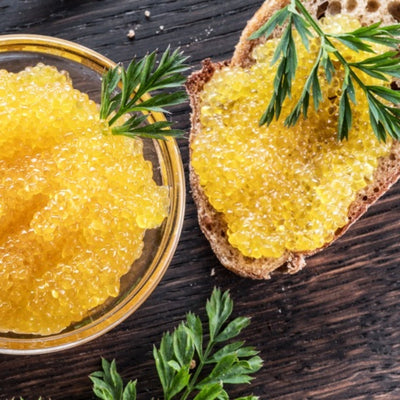
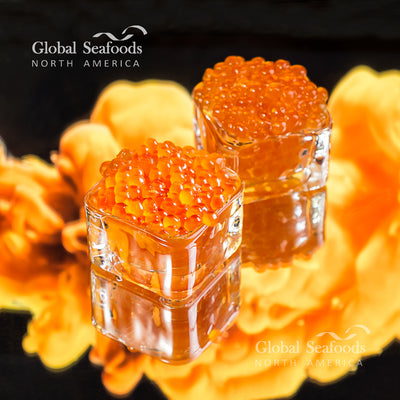
Coho ikura (4–5mm beads) has a more assertive flavor profile than Pink or Keta ikura — bolder brine, more pronounced oceanic character, higher fat content that gives a rich finish. The membrane is medium-firm: a clear, defined pop with less resistance than Keta but more than Pink. Color: vivid deep orange-red with high gloss when fresh. Late-run Coho (October–November harvest) produces the richest roe of the season as the fish’s fat reserves are at maximum before the freshwater migration.
Coho ikura is one of the best varieties for standalone tasting — its flavor is assertive enough to be the centerpiece of a blini or toast point without additional seasoning. It is also well-suited to shoyu-zuke (soy sauce marinade) preparation and to pairing with Blanc de Blancs Champagne, where its boldness complements the wine’s fine acidity.
How to serve red caviar at a New Year’s tasting
Temperature: Serve straight from 28–32°F — bring to the table in the jar or a small serving dish nested in crushed ice. Do not let caviar sit at room temperature for more than 15–20 minutes before service.
Utensils: Mother-of-pearl, bone, or food-grade plastic spoons only. No metal (reacts with brine, imparting metallic off-flavor within seconds). No wood (porous; absorbs brine and bacteria).
Portioning: 10–15g (approximately 1–1.5 tsp) per person per tasting serving. For a New Year’s appetizer course, 20–30g per person is a standard portion alongside blinis or toast points.
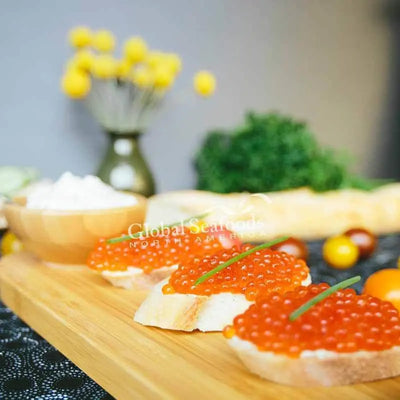
Classic pairings: Blinis with crème fraîche — the mild, slightly tangy crème fraîche is the cleanest backdrop for the caviar’s flavor. Toast points with unsalted butter — butter amplifies richness; use good-quality European-style butter. Cucumber rounds with crème fraîche — a lighter, refreshing alternative for a tasting format where you want the caviar flavor without bread heaviness.
Drinks: Chilled vodka (neutrality and cold cleanse the palate between bites); Blanc de Blancs Champagne or dry Prosecco (fine acidity and fine bubbles complement the brininess); dry sake (mineral, umami character pairs well with salmon roe specifically); sparkling water with lemon for non-alcoholic.
Pasta: For a main course application, fold into warm linguine strictly off heat — remove the pan from the burner entirely before adding caviar. Toss with good olive oil, a small amount of garlic cooked in butter (off heat before adding roe), and finish with the caviar. Heat above approximately 140°F destroys the membrane and breaks down the delicate flavor compounds. The caviar should never touch a hot surface.
Sushi: Use as nigiri topping or as a roll garnish. Coho ikura’s assertive flavor pairs well with mild rice and nori; a drop of soy sauce on the rice only (not directly on the roe) provides salt without the metallic risk of metal utensil contact.
After opening: Consume within 3–4 days, tightly sealed at 28–32°F. Do not freeze after opening.
Also explore: Rainbow Trout Pearls • Golden Pearls Brook Trout Caviar.
Videos: Global Seafoods YouTube Channel.
Related Products


Also in Video

Salmon Tender Monroe: Inside a Suquamish Tribal Vessel Unloading Wild Salmon
The Salmon Tender Monroe is a Suquamish Nation vessel operating in Puget Sound — collecting wild salmon from tribal fishing boats and delivering them to shore. This is the story of a living treaty right, a working vessel, and the wild salmon that have sustained the Suquamish people for thousands of years.

Vietnam Fisherman: Small Boat Leaving Lang Co Bay for the Night Catch
As the sun drops behind the Hải Vân Pass, a lone Vietnamese fisherman pushes off from Lang Co Bay and heads into the darkness of the South China Sea. This is the story of a single boat, a single night, and the ancient rhythm of fishing that still feeds communities across central Vietnam.

Lang Co, Vietnam: Inside the Coastal Fishing Life That Feeds a Nation
Lang Co is one of Vietnam’s most beautiful and storied fishing communities — a narrow strip of land between a turquoise lagoon and the South China Sea. This is the story of the fishermen, their boats, and the wild seafood traditions that have sustained this village for generations.
Shop Now
Main
