
The Journey of Live King Crab: From Ocean to Table

Live King Crab: From Ocean to Table
Live King Crab shipped directly from the North Pacific represents one of the most logistically demanding premium food products available to consumers. Unlike pre-cooked frozen crab legs — which are cooked at sea and require only reheating — live King Crab requires maintaining the animal's vitality through harvest, inspection, packaging, transit, and final delivery, then cooking the live animal at home. Every link in that chain matters: a crab that dies in transit before cooking begins to decompose, and the flavor of dead-before-cooking crab is markedly inferior to live-cooked. This guide covers how Global Seafoods manages that chain, and what you need to do when your live crab arrives.
Mercury: King crab is FDA "Best Choices" — the safest mercury category. No weekly serving limit. Safe for pregnant women, nursing mothers, and children. Source: FDA Advice About Eating Fish.
Products: Live King Crab • Alaskan Red King Crab Legs Jumbo • Deliciously Fresh King Crab Legs • King Crab Leg Pieces • Golden King Crab.
Sourcing and sustainability
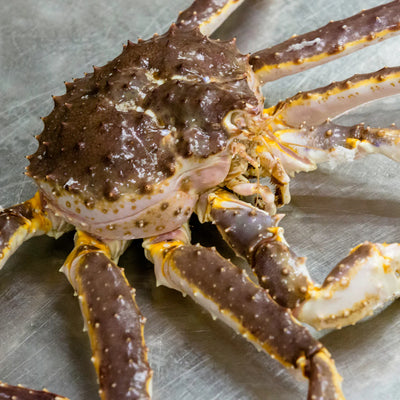
Alaska Red King Crab (Paralithodes camtschaticus) is harvested in the Bering Sea and North Pacific by commercial trap fisheries. The fishery is managed by the Alaska Department of Fish and Game under strict Individual Fishing Quota (IFQ) systems that set annual catch limits based on stock assessments. Trap fishing has lower bycatch impact than trawl methods. Global Seafoods sources from fishermen using trap gear and prioritizing sustainable harvesting practices. Every crab is inspected onshore for activity, shell integrity, and overall health; only animals meeting vitality standards are selected for live shipment.
How live shipping works
Live King Crab is shipped in insulated containers with temperature-regulating gel packs that maintain a cold, dormant state (32–40°F). The cold slows the crab's metabolism, reducing oxygen demand and extending survival time in transit. Specially designed packaging allows controlled airflow — marine crabs need oxygen, and sealed airtight containers would be fatal. Under these conditions, live King Crab survives up to 48 hours in transit. All live King Crab from Global Seafoods ships via overnight or two-day express. If you receive a crab that appears inactive but is still cold, it may simply be dormant — place it in a bowl of cold saltwater briefly; a live dormant crab will typically begin moving. If it does not respond and has an off odor, contact Global Seafoods immediately.
When your live crab arrives: storage and care
Inspect immediately upon arrival. If the crab is alive and active, cook as soon as possible — ideally within a few hours of receipt. If you need to hold it: place the crab in the refrigerator (32–40°F) covered with a damp cloth or damp newspaper — this maintains humidity without submerging the crab. Do not submerge live King Crab in fresh water — it is a saltwater animal and fresh water will kill it quickly. Do not seal it in an airtight container. Cook within 24 hours of delivery for best quality. Do not freeze a live crab — kill and cook it first, then freeze the cooked meat if storage is needed.
How to cook live King Crab
Step 1 — Humane dispatch (chill first): Place the live crab in the freezer for 15–20 minutes before cooking. The cold renders the crab insensible — this is the standard humane pre-cooking practice recommended by culinary and animal welfare sources for live crustaceans. Do not freeze solid; 15–20 minutes is sufficient.
Step 2 — Steam or boil: Steaming (preferred): Bring 2–3 inches of heavily salted water to a rolling boil in a large pot with a steamer rack. Place the crab on the rack; cover tightly. Steam 15–20 minutes for a 2–3 lb crab (add 5 minutes per additional pound). Done when the shell is uniformly bright red and the meat is opaque and white throughout. Boiling: Bring a large pot of heavily salted water (as salty as seawater — approximately 1/4 cup salt per gallon) to a rolling boil. Submerge the crab; boil the same timing as above. Steaming is generally preferred as it produces slightly sweeter, less waterlogged meat.
Step 3 — Rest and serve: Rest 3–5 minutes after cooking. Crack legs with a mallet or seafood crackers; use picks to extract meat from the joints. Serve with clarified butter, lemon, and your choice of sides. Freshly cooked live King Crab will be noticeably sweeter and more delicate than pre-cooked frozen product — the flavor difference is the entire reason to buy live.
Videos: Global Seafoods YouTube Channel.

Related Products


Also in Video

Salmon Tender Monroe: Inside a Suquamish Tribal Vessel Unloading Wild Salmon
The Salmon Tender Monroe is a Suquamish Nation vessel operating in Puget Sound — collecting wild salmon from tribal fishing boats and delivering them to shore. This is the story of a living treaty right, a working vessel, and the wild salmon that have sustained the Suquamish people for thousands of years.

Vietnam Fisherman: Small Boat Leaving Lang Co Bay for the Night Catch
As the sun drops behind the Hải Vân Pass, a lone Vietnamese fisherman pushes off from Lang Co Bay and heads into the darkness of the South China Sea. This is the story of a single boat, a single night, and the ancient rhythm of fishing that still feeds communities across central Vietnam.

Lang Co, Vietnam: Inside the Coastal Fishing Life That Feeds a Nation
Lang Co is one of Vietnam’s most beautiful and storied fishing communities — a narrow strip of land between a turquoise lagoon and the South China Sea. This is the story of the fishermen, their boats, and the wild seafood traditions that have sustained this village for generations.
Shop Now
Main
