
Expert Techniques for Mastering Sturgeon Caviar: Advanced Insights and Recipes

Expert Techniques for Mastering Sturgeon Caviar: Advanced Insights and Recipes
Handle note: Current URL handle is the-perfect-sturgeon-caviar-appetizers-for-your-next-event, which does not match this article's title or content. A redirect from the old handle to a corrected handle (expert-techniques-mastering-sturgeon-caviar or similar) is recommended before updating. Not auto-updated per site policy.
This guide is for cooks, sommeliers, and food professionals who already understand basic caviar service and want to go deeper: advanced differentiation between varieties, non-standard pairing strategies, professional-grade storage techniques, and restaurant-level recipes that use caviar as a structural element rather than just a garnish.
Advanced variety differentiation
At the expert level, caviar evaluation moves beyond "large vs. small" and "light vs. bold" to a more layered sensory vocabulary. Bead size and membrane: Kaluga (Huso dauricus) and Ossetra (A. gueldenstaedtii) both produce medium-large beads, but Kaluga has a thinner, more delicate membrane that gives a cleaner pop and faster flavor release. Ossetra's slightly firmer membrane delivers a more sustained burst. Finish length: Kaluga and Ossetra both have lingering finishes (10–15 seconds) with evolving nutty-briny-oceanic notes. Siberian (A. baerii) has a shorter, cleaner finish — appropriate for preparations where caviar should support rather than dominate. Sevruga (A. stellatus) has the most aggressive brine and the shortest finish, making it better for high-contrast pairings. Color as flavor signal: Within Ossetra, lighter (golden-brown) grades come from older fish and typically have a more complex, nutty flavor with less salinity. Darker grades are from younger fish with a more straightforwardly briny profile. This applies across species: generally, lighter color within a species correlates with older fish, less salt, and greater flavor complexity. Fat content: Caviar's mouthfeel is largely a function of its omega-3 fatty acid content, which varies by species and fish age. Kaluga and Ossetra have notably higher fat content than Sevruga, which contributes to their creamier, more persistent mouthfeel.
Varieties: Kaluga | Ossetra | Siberian | Sevruga | California White Sturgeon | Beluga-Style (Kaluga hybrid)
Professional storage
Temperature: 28–32°F (-2 to 0°C). A dedicated caviar refrigerator or the coldest section of a commercial reach-in (back bottom shelf, away from door) is ideal. Temperature fluctuation is more damaging than a steady slightly-warmer temperature. Opened tin handling: Consumer vacuum sealers are not recommended for opened caviar tins — the pressure differential can rupture egg membranes. The professional standard is modified atmosphere packaging (nitrogen flush) for commercial operations, or for service use: press food-grade plastic wrap directly onto the caviar surface to eliminate air contact, close the tin, and return to 28–32°F immediately. Consume within 48–72 hours. Cross-contamination: Store caviar away from any strong-smelling foods. Even a closed tin can pick up refrigerator odors through its seal over time. A sealed container within the refrigerator adds protection for multi-day storage. Service timing: Remove from refrigerator no more than 5 minutes before plating; open tin at the pass or table, not in advance.
Advanced pairings
Dry Champagne remains the consensus benchmark. The pairing works because high acidity and fine carbonation cut fat and salt, resetting the palate between bites. Blanc de Blancs (100% Chardonnay) is slightly preferred over Blanc de Noirs for the most delicate caviars. Junmai Daiginjo sake: A highly polished (50%+ rice removed), dry Junmai Daiginjo has a delicate floral-mineral character that pairs exceptionally well with Ossetra and Kaluga. The umami alignment between sake and caviar is natural; the absence of acidity produces a different but equally valid experience to Champagne. Increasingly served at high-end omakase and tasting-menu restaurants. Aged vodka (wheat or rye based): A high-quality wheat vodka (Belvedere, Grey Goose) served at −18°C has viscosity and neutral sweetness that envelops caviar without competing. Rye-based vodkas add a subtle spice that works particularly well with Sevruga. Añejo tequila: A creative pairing: the vanilla-caramel barrel notes of a well-aged Añejo contrast with the brine of mild caviars (California White Sturgeon, Siberian) in a way that amplifies the caviar's sweeter, more oceanic notes. Not traditional; appropriate for a single exploratory course rather than a full service. Dry Junmai sake (not Daiginjo): More savoury and earthy; pairs better with Sevruga than delicate varieties. Pairings to avoid: Tannic red wines — tannins clash with iodine/brine. Heavily oaked white wines. Flavored vodkas. Sweet Champagne.
Expert-level recipes
1. Sous vide egg yolk with caviar
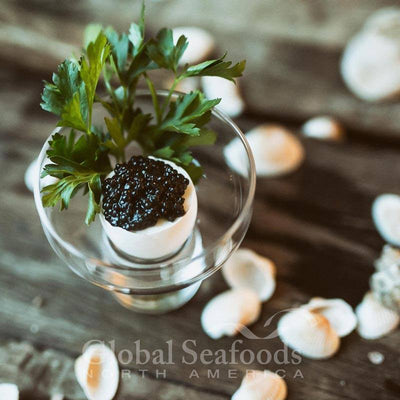
Separate eggs; place individual yolks in vacuum bags with a few drops of olive oil. Sous vide at 64°C for 45–60 minutes. Carefully transfer each yolk to a warmed porcelain or mother-of-pearl spoon. Top with ½ tsp Kaluga or Ossetra caviar cold from refrigeration. Garnish with a microgreen and a single fleck of fleur de sel. The yolk's jammy, fatty texture against the cold caviar pop is the entire point of the dish; serve and eat within 30 seconds of assembly.
2. Tartare with caviar
Finely hand-chop sushi-grade yellowtail or bluefin tuna. Season conservatively (small amount of shallot brunoise, a few capers, ¼ tsp Dijon, white pepper, lemon juice). The tartare base should be lightly flavored — do not add salt, as the caviar provides it. Mold onto toasted brioche rounds. Top immediately before service with ½ tsp Kaluga caviar. The fat of the fish and the brioche creates a triple-fat-texture stack (fish / brioche butter / caviar) that benefits from the caviar's brine as the only salt source.
3. Caviar-finished beurre blanc
Make a classic beurre blanc (shallot-white wine-lemon reduction, mounted with cold unsalted butter). Off heat and just before plating, fold in ½ tsp Ossetra or Siberian caviar per portion. Do not stir aggressively — fold gently to preserve bead integrity. Plate immediately over poached halibut, turbot, or scallop. The caviar's brine seasons the sauce while the fat of the butter extends and smooths it. This is preferable to "caviar butter" (mixing caviar into compound butter) which subjects the eggs to mechanical stress and room-temperature fat absorption, degrading their texture and flavor.
4. Molecular: caviar air or foam
Blend caviar brine (the liquid in the tin, not the eggs themselves) with lecithin (0.3% by weight). Use an immersion blender at the surface to create a stable foam. Spoon the foam over a simply prepared dish (oyster, sea urchin, scallop crudo) for caviar flavor without the textural commitment. The actual eggs can then be used separately as a more controlled garnish. This technique extracts maximum flavor value from the brine that would otherwise be discarded.
Related Products


Also in News

Snail Caviar: How White Escargot Caviar Is Farmed, Harvested and Made

The Dark Years of Pacific Salmon: A 20-Year Outlook for Alaska, Russia, and the Red Caviar Market

King Crab Legs Delivery: Is It Worth It? Exploring the Benefits and Best Options
Shop Now
Main
