
The Best Places to Buy Beluga Caviar Online: A Guide to Exquisite Taste

The Best Places to Buy Beluga Caviar Online: A Guide to Exquisite Taste
Buying caviar online requires more trust than buying most perishable foods — you cannot inspect the product before purchase, and a cold-chain failure or quality issue will not reveal itself until you open the tin. This guide covers what distinguishes a reliable online caviar seller, what to look for in product listings, and how to evaluate whether you are getting what you are paying for. It also covers the important regulatory context: since 2005, wild Huso huso beluga caviar cannot be imported or sold in the United States; all US-market "beluga" or "beluga-style" caviar is Kaluga hybrid (Huso dauricus × Acipenser schrenckii), a legal and genuinely close substitute.
What to look for in an online caviar seller
Sourcing transparency: Reputable sellers identify the sturgeon species, farm location or country of origin, and processing date. "Beluga caviar" without further specification is a red flag — it should specify Kaluga hybrid or the producing farm. CITES documentation or farm certification (BAP, ASC, or equivalent) demonstrates legal and ethical sourcing. Cold-chain shipping: Fresh malossol caviar must be kept at 28–32°F. Overnight or two-day insulated shipping with gel packs is the standard for reputable sellers. Avoid sellers offering standard ground shipping for fresh caviar. Best-by date disclosure: Fresh malossol has a short shelf life (typically 4–6 weeks from processing); the best-by date should be visible in the product listing or on the tin. Return/freshness policy: A seller confident in their cold chain will stand behind freshness on arrival. Price as a quality signal: Genuine Kaluga hybrid beluga-style caviar in 1 oz quantities typically runs $40–$120 depending on grade and seller. Prices significantly below this range warrant scrutiny — lower-grade or mislabeled product is a real risk in the caviar market.
Global Seafoods
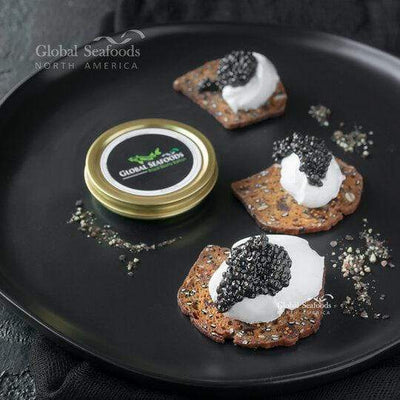
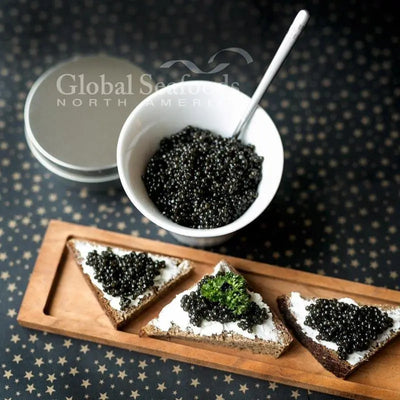
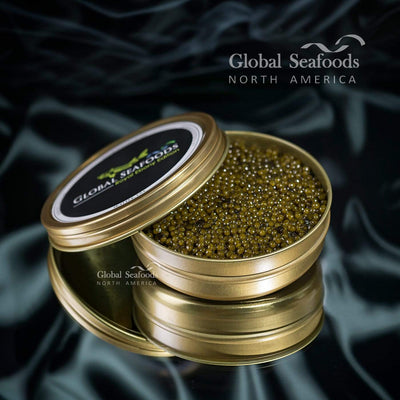
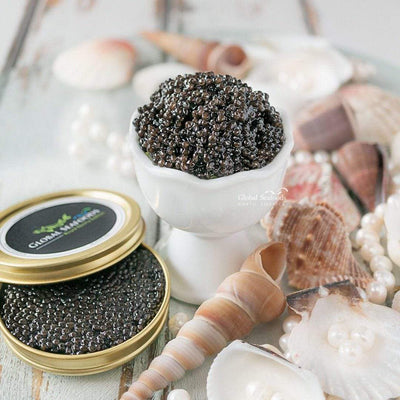
Global Seafoods focuses on sustainably sourced seafood with temperature-controlled shipping and transparent product descriptions. Their beluga-style offering is Kaluga hybrid caviar, which produces large pearls with the buttery, creamy flavor profile associated with traditional beluga. Full caviar selection:
- Beluga (Kaluga Hybrid) Caviar — large pearls, creamy finish
- Kaluga Caviar — pure Kaluga, "river beluga," similar profile
- Ossetra Sturgeon Caviar — medium pearls, nuttier flavor
- Siberian Sturgeon Caviar — firmer texture, mild flavor, accessible price
- White Sturgeon Caviar — California farmed, clean flavor
- Sevruga Caviar — small pearls, most assertive flavor
Other established online caviar sellers
Several other retailers have long track records in the US online caviar market and are worth knowing as reference points when comparing options:
Petrossian (petrossian.com): Founded in Paris in 1920; the most historically prominent caviar brand in the Western market. US operations based in New York. Known for consistent quality, elegant packaging, and a wide range beyond caviar. A reliable benchmark for premium product.
Caviar Russe (caviarrusse.com): New York-based specialty retailer with a restaurant and retail operation. Known for detailed product traceability and hand-selected stock. Good educational resources for first-time buyers.
Marky's Caviar (markys.com): Miami-based; direct partnerships with sturgeon farms worldwide; wide selection including caviar accessories (mother-of-pearl spoons, serving sets). Strong range for comparison shopping across grades and species.
Imperia Caviar (imperiacaviar.com): Focuses on accessibility; subscription delivery model; more affordable entry-level options alongside premium grades.
How to evaluate what you receive
When your caviar arrives: check the tin temperature on arrival (should feel very cold; gel packs should still be partially frozen or cold). Inspect the tin — it should be vacuum-sealed with no visible damage. When you open it: pearls should be separate and glossy, not broken or mushy; the aroma should be clean and oceanic, not sulfurous or ammonia-like. If the product arrives warm or the pearls are broken, contact the seller immediately — reputable sellers will replace or refund product damaged in transit.
For serving guidance and pairing ideas, subscribe to the Global Seafoods YouTube Channel. Browse the full caviar range at Global Seafoods Caviar Collection.



Related Products


Also in News

Snail Caviar: How White Escargot Caviar Is Farmed, Harvested and Made

The Dark Years of Pacific Salmon: A 20-Year Outlook for Alaska, Russia, and the Red Caviar Market

King Crab Legs Delivery: Is It Worth It? Exploring the Benefits and Best Options
Shop Now
Main
