
Beluga Caviar: A Luxurious Delicacy with Rich History and Unique Benefits

Beluga Caviar: A Luxurious Delicacy with Rich History and Unique Benefits
Beluga caviar is the most celebrated and historically prestigious caviar in the world — large pearls, pale gray to dark gray color, a distinctly creamy and buttery flavor with a lingering finish that distinguishes it from the nuttier Ossetra or the more assertive Sevruga. For centuries it was synonymous with the Caspian Sea and the courts of Russia, Iran, and Ottoman-era Turkey. Understanding what beluga caviar is, why it commands its price, and how to serve it properly requires separating the history and flavor science from the mythology.
What is beluga caviar
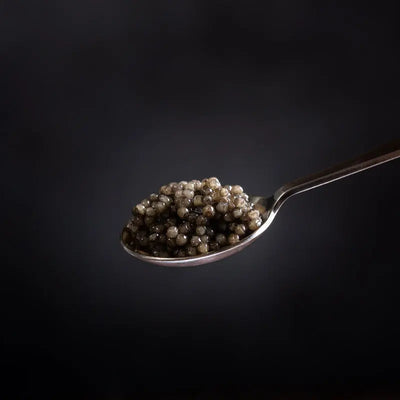
Traditionally, beluga caviar refers to the roe of the beluga sturgeon (Huso huso), the largest freshwater fish in the world and the source of the largest-grained caviar of any sturgeon species — pearls ranging from 3.5 to 4+ mm in diameter. The size is significant because larger eggs contain more fat, which is the primary driver of the buttery, creamy mouthfeel beluga is known for. Color ranges from pale silver-gray to dark gray depending on the individual fish; the lightest grades have historically commanded the highest prices.
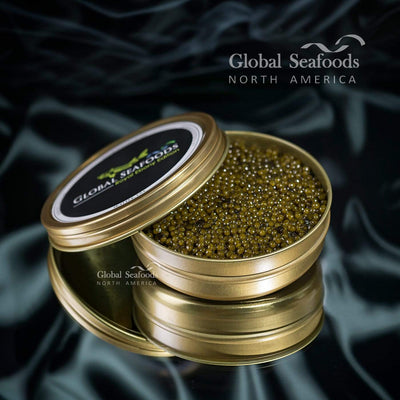
Important note for US buyers: The importation and sale of wild Huso huso beluga caviar has been prohibited in the United States since 2005 under CITES Appendix I listing and US Endangered Species Act enforcement. What is sold in the US market as "beluga" or "beluga-style" caviar — including the product offered by Global Seafoods — is Kaluga hybrid caviar, produced from farmed crosses of Kaluga (Huso dauricus) and Amur sturgeon (Acipenser schrenckii). This is a legitimate, legal, and high-quality product: Kaluga hybrid produces very large pearls with a flavor profile genuinely close to traditional Huso huso, which is why it became the primary US market substitute. It is not a lesser product — it is a different species farmed sustainably and graded to the same standards. Shop Beluga (Kaluga Hybrid) Caviar at Global Seafoods.
History
Beluga sturgeon have been harvested for roe in the Caspian and Black Sea basins for at least 1,000 years. Russian and Persian imperial courts established caviar as a luxury product by the 18th century — served at state banquets and royal celebrations, exported to European aristocracy, and eventually becoming a defining feature of haute cuisine by the late 19th and early 20th centuries. The Soviet-era state fisheries in the Caspian standardized the grading system (Malossol — lightly salted) that remains the standard globally today. Wild Huso huso populations collapsed through the late 20th century due to overfishing, poaching, and Volga River dam construction blocking spawning migrations. Conservation listings followed, and the commercial wild fishery effectively ended in the 2000s. All commercially available beluga-style caviar today comes from aquaculture.
Why it is expensive
Maturation time: Beluga and Kaluga hybrid females reach sexual maturity at 15–20 years in aquaculture settings, longer in the wild. No other food animal has a comparable production timeline. Yield: Roe represents 15–25% of body weight at harvest; a single female may produce 25–50 lbs of caviar after a decade and a half of feeding, housing, and water quality management. Processing: Malossol caviar is salted to 3–5% by weight, graded by size and color uniformity, and packed in tins under specific temperature and pressure conditions. The process is entirely manual at the highest quality levels. Cold chain: Caviar must be held at 28–32°F from processing through delivery; temperature fluctuations destroy texture irreversibly.
Nutritional profile
A 1 oz (28g) serving of caviar contains approximately: 75–80 calories; 7–8g protein (~14–16% of daily value); 4–5g fat (predominantly omega-3 fatty acids — DHA and EPA); meaningful amounts of vitamin B12 (over 200% DV), selenium, iron, and sodium (high — caviar is a salt-cured product). The omega-3 content per serving is comparable to a 3 oz serving of fatty fish. Note that caviar is also high in dietary cholesterol (~165mg per oz); for most healthy individuals the impact of dietary cholesterol on cardiovascular risk is modest, but it is worth noting for context.
How to serve beluga caviar
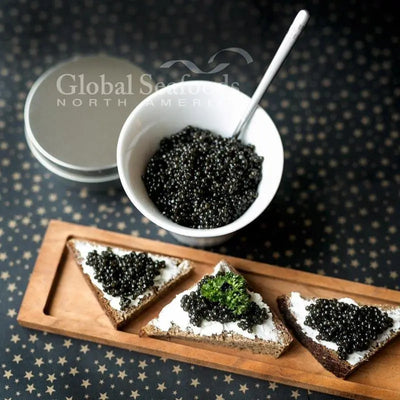
Temperature: Serve straight from the refrigerator, on crushed ice, in the original tin or a chilled non-reactive dish (glass, ceramic, mother-of-pearl). Never serve at room temperature — the fat structure that creates the creamy mouthfeel begins to break down above 40°F. Utensils: Mother-of-pearl, bone, or plastic spoon. Metal (particularly silver) causes oxidation on contact with caviar that produces a metallic off-flavor within seconds. Portion: 10–15g per person as an amuse-bouche; 30–50g per person as a standalone course. Pairings: Champagne (brut, no dosage) or ice-cold vodka are the classic choices — both are neutral enough not to compete with the caviar's flavor. Blinis with crème fraîche, lightly buttered toast points, or simple baguette. Avoid acidic or strongly flavored accompaniments that will overpower the delicate fat-forward flavor. What not to do: Do not serve with smoked salmon alongside — the smoke overwhelms the caviar. Capers and red onion are traditional but mask the caviar's flavor for tasting purposes; use them for composed bites, not for evaluation.
Storage
Unopened: 28–32°F, in the coldest part of the refrigerator (not the door). Check the best-by date — fresh malossol caviar is typically 4–6 weeks from processing. Opened: consume within 2–3 days; press plastic wrap directly against the surface to minimize air contact before re-sealing. Do not freeze fresh malossol caviar — ice crystals rupture the egg membranes and destroy the texture. (Pasteurized caviar has different handling requirements and a longer shelf life.)
Alternatives and comparisons
Kaluga Caviar: Pure Kaluga (Huso dauricus) — similar large pearl size, buttery flavor, considered the closest alternative to traditional beluga. Often described as "river beluga." Ossetra Sturgeon Caviar: Smaller pearls, nuttier and more complex flavor than beluga, more assertive brine. The choice for those who prefer a more defined flavor over beluga's neutral creaminess. Sevruga Caviar: Smallest pearls, strongest flavor, most assertive salt — not a beginner caviar; best for experienced caviar eaters who want intensity. Siberian Sturgeon Caviar: Good entry-level option; firmer texture, milder flavor, widely farmed, more accessible price point. White Sturgeon Caviar: California farmed; clean, mild flavor, medium pearl size. The domestic US alternative.
For serving videos and pairing ideas, subscribe to the Global Seafoods YouTube Channel.
Related Products


Also in News

Snail Caviar: How White Escargot Caviar Is Farmed, Harvested and Made

The Dark Years of Pacific Salmon: A 20-Year Outlook for Alaska, Russia, and the Red Caviar Market

King Crab Legs Delivery: Is It Worth It? Exploring the Benefits and Best Options
Shop Now
Main
