
The Most Unique Ikura Sushi Dishes from Around the World

Salmon Roe Around the World: How Japan, Russia, Scandinavia, and the Pacific Northwest Each Developed a Distinct Culinary Tradition for the Same Ingredient
Salmon roe is one of the few luxury ingredients that developed independently as a culinary tradition in multiple cultures simultaneously. Japan, Russia, Scandinavia, and the Indigenous peoples of the Pacific Northwest all developed distinct preparations for salmon roe -- not through cultural exchange, but because salmon roe is abundant in the waters of the North Pacific and North Atlantic, and every culture that fished those waters eventually discovered that the roe was as valuable as the fish. The preparations are completely different: Japanese ikura is salt-cured or soy sauce-cured and served cold on rice; Russian krasnaya ikra is salt-cured and served on buttered bread or blini; Scandinavian preparations range from the delicate Swedish löjrom (vendace roe, not salmon roe, but prepared similarly) to Norwegian salmon roe on crispbread; Pacific Northwest Indigenous preparations include both fresh consumption and preservation through smoking and drying. This article covers each tradition in depth, with the specific preparations, flavor profiles, and serving customs of each culture.
Salmon Roe (Ikura) at Global Seafoods
Japan: Ikura -- The Refined Tradition
Japan's relationship with salmon roe is relatively recent by the standards of Japanese cuisine. Salmon was not traditionally prized in Japanese cuisine -- the fish was considered too fatty and too strongly flavored for the delicate palate of traditional Japanese cooking. It was not until the 1980s, when Norwegian salmon farming made Atlantic salmon widely available and affordable in Japan, that salmon became a popular sushi fish. Ikura, however, has a longer history in Japan, particularly in Hokkaido (Japan's northernmost island), where Pacific salmon have been fished for centuries and the roe was a natural byproduct of the salmon harvest.
The Japanese Preparations
- Gunkan-maki (battleship sushi): the most common Japanese preparation; seasoned sushi rice shaped into an oval, wrapped in a strip of nori to create a cup, filled with ikura; the nori holds the roe in place and provides a textural contrast; the standard preparation at sushi restaurants worldwide
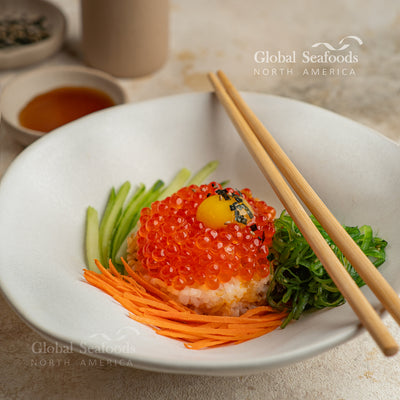
- Ikura don: a bowl of seasoned sushi rice topped with a generous layer of ikura; the definitive Hokkaido preparation; considered one of the great expressions of ikura because the generous quantity of roe allows the full flavor to develop; see the complete ikura don guide
- Ikura ochazuke: cooked rice with hot green tea or dashi broth poured over it, topped with ikura; a traditional Japanese comfort food; the heat of the broth gently warms the roe and causes it to release its flavor into the broth
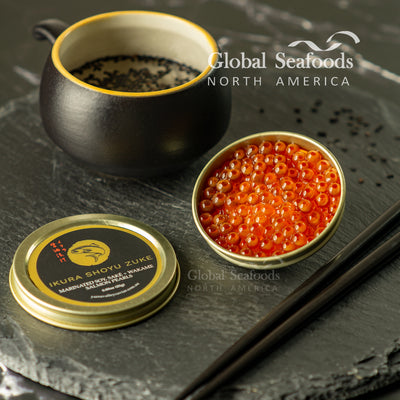
- Shoyu-zuke ikura: ikura marinated in soy sauce, mirin, and sake; the soy sauce adds umami depth and a slightly sweet, savory complexity; the most common preparation in Japanese sushi restaurants; considered the premium preparation for sushi use
The Japanese Flavor Philosophy
Japanese ikura preparations are characterized by restraint and precision: the roe is the star; the rice, nori, and soy sauce are supporting elements; the goal is to present the ikura at its peak freshness with minimal interference; the serving temperature is critical (cold ikura on slightly warm rice); the quantity per piece is carefully calibrated; the visual presentation (the vibrant orange-red of the roe against the white rice and dark nori) is considered as important as the flavor.
Chum Salmon Caviar | Coho Salmon Caviar
Russia: Krasnaya Ikra -- The Democratic Luxury
In Russia, salmon roe is called krasnaya ikra (red caviar), distinguishing it from chyornaya ikra (black caviar, from sturgeon). While black caviar has historically been the prestige product associated with the Russian aristocracy and Soviet elite, red caviar has always been the more democratic luxury -- widely available, affordable relative to black caviar, and deeply embedded in everyday Russian food culture. Red caviar is not a special-occasion food in Russia; it is a staple that appears on the table at breakfast, at holiday celebrations, and at everything in between.
The Russian Preparations
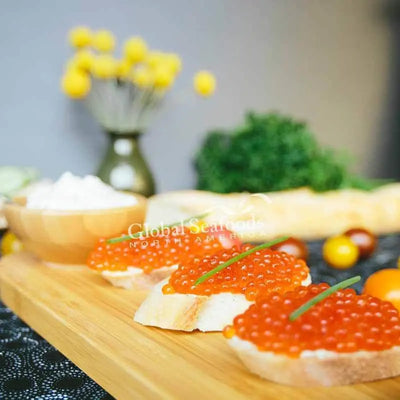
- Buterbrody s ikroy (open-faced sandwiches with caviar): the most common everyday preparation; a thick slice of white bread (or black rye bread) spread generously with unsalted butter, topped with a thick layer of red caviar; the butter is essential -- it provides fat that carries the flavor of the roe and prevents the bread from becoming soggy; this is the Russian equivalent of avocado toast in terms of ubiquity and cultural significance
- Blini s ikroy (blini with caviar): the festive preparation; small buckwheat pancakes (blini) served with smetana (Russian sour cream, richer and less acidic than Western sour cream) and red caviar; the buckwheat in the blini has a slightly nutty, earthy flavor that complements the brininess of the roe; blini with caviar is the traditional food of Maslenitsa (Butter Week, the Russian equivalent of Mardi Gras) and is served at celebrations and formal occasions
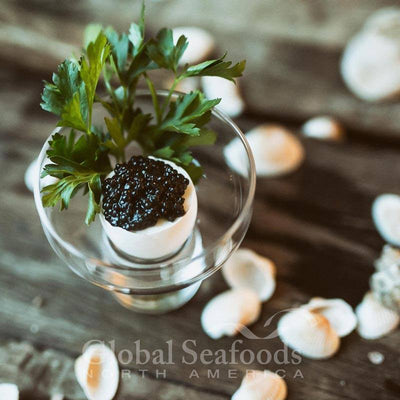
- Ikra na yaytsakh (caviar on eggs): hard-boiled eggs halved and topped with red caviar; a common appetizer (zakuska) at Russian celebrations; simple, elegant, and effective
- Pirozhki s ikroy (pastries with caviar): small baked or fried pastries filled with red caviar and rice; a traditional Russian street food and celebration food
The Russian Flavor Philosophy
Russian red caviar preparations are characterized by generosity -- the roe is used in quantities that would be considered extravagant in Japanese cuisine; the butter or smetana provides a rich, fatty base that amplifies the flavor of the roe; the bread or blini provides a neutral, starchy base; the overall effect is rich, satisfying, and deeply savory; the Russian approach treats red caviar as a condiment to be used liberally rather than a precious ingredient to be used sparingly.
Russian vs. Japanese Curing
Russian krasnaya ikra is typically more heavily salted than Japanese ikura: Russian red caviar is often cured at 4-6% salt by weight (vs. 3-5% for Japanese ikura); the higher salt content extends the shelf life and produces a more intensely briny flavor; Russian red caviar is also typically larger-grained (chum or sockeye salmon roe) and has a firmer texture than the Japanese preference for slightly softer roe.
Trout Red Caviar | Golden Pearls Brook Trout Caviar
Scandinavia: Lojrom and Salmon Roe -- The Nordic Tradition
Scandinavia has its own distinct roe tradition, centered on two products: lojrom (vendace roe, from the vendace fish of Swedish and Finnish lakes) and salmon roe from the Atlantic salmon and sea trout of Norwegian and Swedish waters. Scandinavian roe preparations are characterized by simplicity and a focus on the natural flavor of the roe -- the Nordic culinary philosophy of letting high-quality ingredients speak for themselves.
Lojrom: Sweden's Native Roe Delicacy
Lojrom (pronounced "lur-yrom") is the roe of the vendace (Coregonus albula), a small freshwater fish found in the cold, clear lakes of Sweden and Finland: (1) What it is: very small, pale orange eggs with a delicate, slightly sweet flavor and a fine, even texture; considered one of the great roe delicacies of Northern Europe; (2) How it is served: the classic Swedish preparation is lojrom on blini or toast with creme fraiche, finely minced red onion, and fresh dill; the simplicity of the preparation is intentional -- the delicate flavor of the lojrom is easily overwhelmed; (3) Protected designation: lojrom from the Kalix region of northern Sweden has a Protected Designation of Origin (PDO) under EU law, similar to Champagne or Parmigiano-Reggiano; only lojrom harvested from the Kalix River and its tributaries can be labeled "Kalix lojrom"; (4) Comparison to ikura: lojrom is smaller, more delicate, and less briny than salmon roe; it is the most delicate of all the roe traditions covered in this article; the closest commercially available equivalent is golden brook trout caviar.
Norwegian and Swedish Salmon Roe Preparations
- Salmon roe on crispbread (knackebrod): the most common Scandinavian salmon roe preparation; a thin, crisp rye crispbread spread with butter or cream cheese, topped with salmon roe, fresh dill, and a squeeze of lemon; the crispbread provides a neutral, crunchy base that contrasts with the soft, popping roe
- Salmon roe with scrambled eggs: a classic Scandinavian breakfast preparation; soft scrambled eggs topped with salmon roe and fresh dill; the richness of the eggs amplifies the flavor of the roe; similar in concept to the Japanese ikura omelette but with a different flavor profile (dill vs. soy sauce)
- Gravlax with salmon roe: gravlax (salt-and-sugar-cured salmon) served with salmon roe as a garnish; the cured salmon and the fresh roe provide complementary expressions of the same fish
The Scandinavian Flavor Philosophy
Scandinavian roe preparations are characterized by restraint, freshness, and the use of complementary Nordic flavors (dill, lemon, cream, rye); the roe is used as a featured ingredient rather than a condiment; the preparations are simple and elegant; the overall effect is clean, bright, and refreshing.
Pacific Northwest: Indigenous Salmon Roe Traditions
The Indigenous peoples of the Pacific Northwest -- including the Tlingit, Haida, Tsimshian, Nisga'a, Gitxsan, and many other nations -- have harvested and consumed salmon roe for thousands of years. Salmon is the central food of Pacific Northwest Indigenous cultures, and the roe has always been considered a prized part of the fish, not a byproduct.
Traditional Preparations
- Fresh roe: fresh salmon roe was consumed immediately after harvest, often eaten directly from the skein (the membrane that holds the eggs together); the fresh roe has a clean, oceanic flavor without the saltiness of cured roe; this is the purest expression of salmon roe flavor
- Dried roe: salmon roe was dried in the sun or over a fire to preserve it for winter; dried roe has a concentrated, intensely savory flavor and a chewy texture; it was eaten as a snack or rehydrated in soups and stews
- Smoked roe: salmon roe was cold-smoked or hot-smoked to preserve it and add flavor; smoked salmon roe has a complex, smoky, savory flavor that is distinct from both fresh and salt-cured roe; it is still produced by some Pacific Northwest Indigenous communities and specialty producers
- Roe with eulachon grease: eulachon (oolichan) is a small, extremely oily fish that was rendered into grease (a highly prized fat in Pacific Northwest Indigenous cuisine); salmon roe was sometimes eaten with eulachon grease, which amplified the flavor of the roe in the same way that butter amplifies the flavor of Russian red caviar
Cultural Significance
In Pacific Northwest Indigenous cultures, salmon roe is not a luxury ingredient -- it is a staple food with deep cultural and spiritual significance; the salmon is considered a sacred being that gives itself to the people; every part of the fish, including the roe, is used and respected; the harvest of salmon roe is governed by traditional ecological knowledge that has maintained salmon populations in the Pacific Northwest for thousands of years; this traditional knowledge is increasingly recognized by fisheries managers as a valuable complement to Western scientific management.
Wild Alaskan Salmon Roe Collection at Global Seafoods | Chum Salmon Caviar | Coho Salmon Caviar | Trout Red Caviar
Also see: The Complete Ikura Buyer's Guide | Ikura Fusion: Nine Creative Pairings | Why Wild Alaskan Salmon Roe Is the Most Sustainable Luxury Seafood
Watch seafood preparation videos on the Global Seafoods YouTube Channel
FAQs: Salmon Roe Around the World
What is the difference between Japanese ikura and Russian krasnaya ikra, and can I use them interchangeably?
Japanese ikura vs. Russian krasnaya ikra: (1) Salt content: Russian red caviar is typically more heavily salted (4-6% salt by weight) than Japanese ikura (3-5%); the higher salt content produces a more intensely briny flavor and extends shelf life; (2) Species: both typically use Pacific salmon roe (chum, sockeye, pink); the species used varies by producer and availability; (3) Curing method: Japanese ikura is typically salt-cured or shoyu-zuke (soy sauce-cured); Russian krasnaya ikra is typically salt-cured only; (4) Flavor profile: Japanese ikura (salt-cured) -- clean, briny, slightly sweet; Japanese ikura (shoyu-zuke) -- umami-rich, slightly sweet and savory; Russian krasnaya ikra -- more intensely briny, saltier, more robust; (5) Texture: Russian red caviar is often firmer and more robust than Japanese ikura; the higher salt content firms the egg membrane; (6) Interchangeability: they can be used interchangeably in most preparations; the flavor difference is noticeable but not dramatic; Russian red caviar works well in Japanese preparations (the extra brininess is not out of place); Japanese ikura works well in Russian preparations (the milder flavor is a pleasant variation); (7) What to look for: both are labeled by species (chum, sockeye, etc.) and origin (Alaskan, Russian, etc.); the quality criteria are the same -- look for wild-caught, firm eggs, vibrant color, and a clean oceanic smell.
What is lojrom, and how does it compare to salmon roe?
Lojrom vs. salmon roe: (1) What lojrom is: the roe of the vendace (Coregonus albula), a small freshwater fish found in the cold, clear lakes of Sweden and Finland; considered one of the great roe delicacies of Northern Europe; (2) Size: very small eggs (approximately 1-2mm diameter, compared to 4-6mm for salmon roe); the small size produces a fine, even texture and a different mouthfeel from the pop of salmon roe; (3) Flavor: delicate, slightly sweet, and less briny than salmon roe; the most delicate of all the roe traditions covered in this article; (4) Protected designation: lojrom from the Kalix region of northern Sweden has a Protected Designation of Origin (PDO) under EU law; only lojrom harvested from the Kalix River and its tributaries can be labeled "Kalix lojrom"; (5) Availability: Kalix lojrom is rarely available outside Scandinavia; it is expensive and produced in limited quantities; (6) The closest equivalent: golden brook trout caviar is the closest commercially available equivalent to lojrom in terms of size, color, and delicate flavor; (7) How to serve: the classic Swedish preparation is lojrom on blini or toast with creme fraiche, finely minced red onion, and fresh dill; the simplicity of the preparation is intentional -- the delicate flavor is easily overwhelmed by strong accompaniments.
How did Pacific Northwest Indigenous peoples preserve salmon roe before refrigeration, and what does smoked salmon roe taste like?
Pacific Northwest Indigenous salmon roe preservation: (1) Drying: salmon roe was dried in the sun or over a low fire; the drying process removes moisture and concentrates the flavor; dried roe has an intensely savory, concentrated flavor and a chewy texture; it was eaten as a snack or rehydrated in soups and stews; (2) Smoking: salmon roe was cold-smoked or hot-smoked; cold-smoking (below 90F / 32C) preserves the texture of the eggs while adding a smoky flavor; hot-smoking (above 145F / 63C) partially cooks the eggs, producing a firmer texture and a more cooked flavor; (3) What smoked salmon roe tastes like: cold-smoked salmon roe has a complex, smoky, savory flavor with the underlying brininess of the roe; the smoke adds a layer of complexity that is distinct from both fresh and salt-cured roe; hot-smoked salmon roe has a firmer texture and a more cooked, smoky flavor; (4) Eulachon grease: eulachon (oolichan) grease is a highly prized fat in Pacific Northwest Indigenous cuisine; it was used as a condiment, a cooking fat, and a preservative; salmon roe eaten with eulachon grease has a rich, complex flavor that combines the brininess of the roe with the distinctive flavor of the grease; (5) Modern availability: smoked salmon roe is produced by some Pacific Northwest specialty producers and is available online; it is a distinct product from salt-cured ikura and should be treated as such in recipes.
Related Products


Also in News

Snail Caviar: How White Escargot Caviar Is Farmed, Harvested and Made

The Dark Years of Pacific Salmon: A 20-Year Outlook for Alaska, Russia, and the Red Caviar Market

King Crab Legs Delivery: Is It Worth It? Exploring the Benefits and Best Options
Shop Now
Main
