
How to Enjoy Salmon Caviar – The Ultimate Tasting Guide

How to Enjoy Salmon Caviar: Serving, Tasting, and Pairing Guide
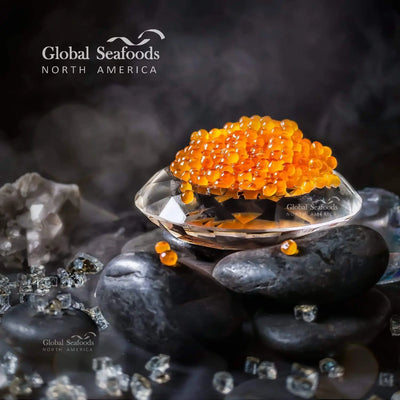
Salmon caviar (ikura) is a salt-cured roe product best experienced in its simplest form first — a small spoonful at refrigerator temperature, no accompaniments — to understand the baseline: clean oceanic brininess on first impression, natural sweetness within 2–3 seconds, a firm membrane that pops cleanly, and a finish that reflects the species character. Everything else in this guide builds on that baseline experience.
Species overview for tasting
- Chum/Keta (4–5mm) — Firmest membrane; clean, balanced flavor; mild brininess, detectable sweetness. Good baseline for comparison.
- Coho/Silver (4–5mm) — Assertive, bold-briny with a rich finish and pronounced sweetness. Most complex Pacific salmon roe flavor. Not buttery — that descriptor belongs to King/Chinook and sturgeon.
- Pink (3–4mm) — Mildest; lightest membrane; most approachable entry point for first-time tasters.
- Trout (3–4mm) — Farmed, year-round; mild with a slight nuttiness; lighter color; consistent quality.
- Golden Pearls Brook Trout — Rare golden color; subtle flavor; specialty presentation item.
How to taste salmon caviar properly
Step 1 — Taste alone first: Place a small amount (roughly ½ tsp) on the back of your hand and transfer to your tongue using a mother-of-pearl or food-grade plastic spoon. No metal — metal reacts with brine within seconds, imparting metallic off-flavor that will distort the tasting. Hold briefly on the tongue, then close your mouth and let the beads pop naturally. Do not bite down aggressively — the pop should be the membrane’s own release, not forced.
Step 2 — Note the sequence: Salt impression first. Then sweetness (2–3 seconds). Then the finish — length, richness, oceanic character. A clean, complete finish with no off-note is the indicator of properly handled, high-quality roe.
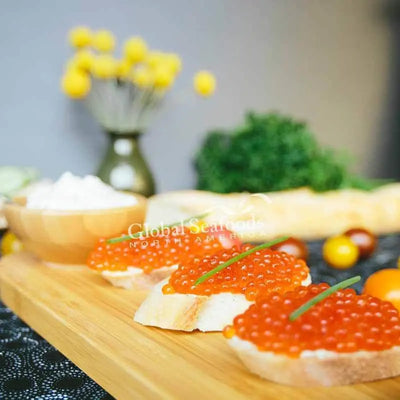
Step 3 — Taste with a neutral base: Plain crème fraîche or unsalted butter on a plain cracker or blini. This reveals how the roe’s salt and flavor interacts with fat — which is the most common service context.
Step 4 — Compare species side by side: If tasting multiple varieties, move from mildest to most assertive (Pink or Trout → Keta → Coho). Cleanse palate with plain water or bread between each. The sequence matters — tasting Coho first will make Pink seem flavorless.
How to serve salmon caviar
Temperature: Straight from 28–32°F. For table service, nest the serving vessel in crushed ice — roe left at room temperature for more than 15–20 minutes softens and loses flavor clarity.
Utensils: Mother-of-pearl, bone, or food-grade plastic only at every stage. Not wood — wood is porous and absorbs brine and bacteria. Not metal.
Classic pairings: Blinis with crème fraîche (the standard fine-dining preparation; mild tang of crème fraîche provides the cleanest backdrop). Toast points with unsalted butter (the salt and fat amplify the roe’s natural sweetness). Soft-boiled or jammy eggs topped at the last moment before serving (cool the egg first; do not add roe to a hot egg).
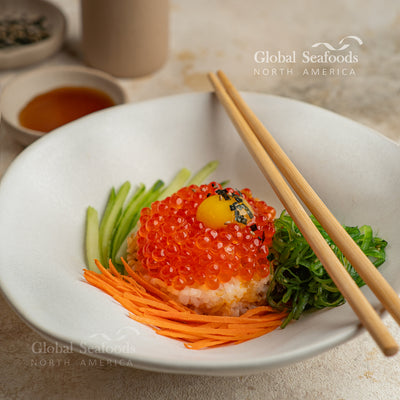
Modern uses: Sushi rolls and nigiri (placed immediately before serving). Avocado toast (neutral fat base; add lemon and minimal salt to avocado only). Deviled eggs (garnish after fully cooling). Caviar butter (fold into softened unsalted butter with dill; spread on crackers or grilled bread). Poke bowls (as a finishing garnish, not mixed in).
Pasta (off-heat only): Fold into warm pasta strictly after removing the pan from all heat sources. The egg membrane ruptures at approximately 140°F — adding roe to a hot pan destroys the pop and degrades flavor. Toss pasta with olive oil and garlic base off heat, then fold in caviar as the absolute last step before plating. Serve immediately.
Drinks: Blanc de Blancs Champagne (fine acidity and bubbles; the standard fine-dining pairing — the CO₂ and acidity reset the palate between bites). Chilled vodka (traditional Eastern European pairing for zakuski). Dry sake (mineral, umami character pairs particularly well with salmon roe). Dry white wine with mineral character (Chablis, Muscadet).
Nutrition highlights
Per oz (28g): ~35–45 calories; ~6g complete protein; omega-3 fatty acids (EPA + DHA) ~700–1,100mg — primarily reducing triglycerides (the primary well-documented cardiovascular benefit; not LDL reduction). Vitamin B12 ~3–5mcg (well above the 2.4mcg RDA). Vitamin D ~50–80 IU. Selenium ~8–12mcg. All Pacific salmon FDA “Best Choices” for mercury. Sources: NIH ODS • FDA Advice About Eating Fish.
Storage
28–32°F continuously; back of bottom refrigerator shelf. After opening: consume within 3–4 days. Press plastic wrap directly onto the roe surface before resealing to minimize air contact. Do not freeze after opening — ice crystals rupture egg membranes on thawing. Some commercially sealed, unopened products can be frozen per the product label guidance; check before freezing.
Also: Rainbow Trout Pearls • Full Red Caviar Collection.
Videos: Global Seafoods YouTube Channel.
Related Products


Also in News

Snail Caviar: How White Escargot Caviar Is Farmed, Harvested and Made

The Dark Years of Pacific Salmon: A 20-Year Outlook for Alaska, Russia, and the Red Caviar Market

King Crab Legs Delivery: Is It Worth It? Exploring the Benefits and Best Options
Shop Now
Main
