
Salmon Caviar Unveiled: The Gourmet Delicacy You Need to Try

Salmon Caviar Unveiled: The Gourmet Delicacy You Need to Try
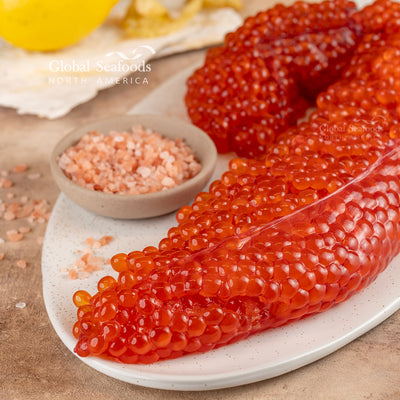
Salmon caviar — known as ikura in Japanese and krasnaya ikra (red caviar) in Russian — is one of the most versatile and accessible premium seafood products in the world. Bright, briny, nutrient-dense, and visually striking, it has been a centerpiece of celebration tables in Russia and Japan for generations, and has become increasingly mainstream in Western gourmet cooking. This guide covers the origins and cultural context of salmon caviar, species differences, nutritional profile, how to serve it correctly, and how to source quality product.
Origins and Cultural Context
Russia: Salmon caviar (red caviar / krasnaya ikra) has been a staple of Russian cuisine for centuries, distinct in tradition from black sturgeon caviar. It became especially prominent in Soviet-era food culture as an affordable alternative to expensive beluga and ossetra caviar — widely available in state stores and a fixture of New Year’s feasts. The classic Russian presentation is on buttered dark rye bread or blini with sour cream. Note: the historical claim that "caviar has roots in ancient Persia" applies specifically to sturgeon caviar (black caviar), not salmon roe; these are separate products with separate histories.
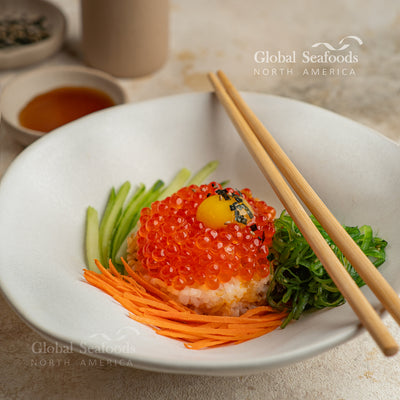
Japan: Ikura entered Japanese cuisine relatively recently — the word itself is borrowed from Russian (ikra, meaning fish roe or caviar). Salmon roe was historically not widely consumed in Japan; it became popular in the mid-20th century and is now one of the most beloved sushi and donburi toppings. The canonical Japanese preparation is ikuradon: seasoned (shoyu-zuke) salmon roe over room-temperature sushi rice, sometimes with shiso, nori, or daikon oroshi.
Global: Today, Alaskan wild-caught Pacific salmon roe is exported to Japan, Russia, and increasingly to the US, EU, and other markets. Global Seafoods sources sustainably harvested Alaskan salmon roe across multiple species.
Species Guide
Chum salmon caviar (Oncorhynchus keta): The largest eggs of the Pacific salmon species (~5–8mm), with a vibrant translucent orange color and the most visually consistent appearance. Flavor is mild, clean, and oceanic — not buttery; chum ikura is the benchmark for Japanese premium ikura presentation and is widely used for ikuradon and gunkan-maki precisely because the mild flavor and large egg size work beautifully with seasoned rice. See: Chum Salmon Caviar.
Coho salmon caviar (Oncorhynchus kisutch): Medium-large eggs (~4–5mm), bright orange (not red — deeper red coloring is characteristic of sockeye roe), with a clean tangy flavor and moderate salinity. Highly versatile — works well in sushi, on blinis, in pasta applications (added after plating), and in Western-style appetizers. See: Coho Salmon Caviar.
Pink salmon caviar (Oncorhynchus gorbuscha): Smallest eggs of the Pacific salmons (~3–4mm), light orange, most delicate and mild flavor — the most affordable and most accessible entry point for first-time caviar eaters. Good for casual presentations, canapés, omelets (added after cooking), and rice bowls. See: Pink Salmon Caviar.
Trout red caviar (rainbow trout roe): Smaller than salmon roe, reddish-orange in color. Flavor is mild and delicate — generally lighter than chum or Coho salmon roe, not bolder. The milder flavor and smaller egg size make it ideal for refined presentations where a more subtle roe character is desired: sushi rolls, composed salads, fine dining garnish. See: Trout Red Caviar.
Specialty options: Golden Pearls Brook Trout Caviar | Rainbow Trout Pearls.
Nutritional Profile
Per 30g (approximately 1 oz / 2 tablespoons) of malossol salmon roe:
- Omega-3 fatty acids (EPA+DHA): ~1,000–1,500mg in phospholipid form — more bioavailable than the triglyceride form in most fish oil supplements. Supports reduced triglyceride levels and cardiovascular health per AHA dietary guidelines.
- Complete protein: ~6–8g, all nine essential amino acids. Supports muscle repair, immune function, enzyme production.
- Vitamin B12: 150–200%+ of daily value — one of the most concentrated natural food sources per calorie.
- Vitamin D: Meaningful contributor; one of the few whole foods naturally rich in Vitamin D.
- Selenium: ~25–40% of daily value — antioxidant enzyme cofactor, thyroid hormone metabolism.
- Astaxanthin: The ketocarotenoid responsible for the bright orange color; one of the most potent antioxidants studied in nature, with documented anti-inflammatory properties.
- Calories: ~40–50 kcal per 30g — very low for the nutrient density delivered.
- Sodium: ~300–500mg per 30g (relevant for those monitoring intake).
- Carbohydrates: Effectively zero.
How to Serve Salmon Caviar
The single most important serving rule: salmon caviar goes on last, using a non-metal spoon, on food that has cooled from hot to warm. Heat collapses the egg membrane, destroying both the pop texture and the flavor. Metal contact imparts metallic off-flavor within minutes.
Classic presentations:
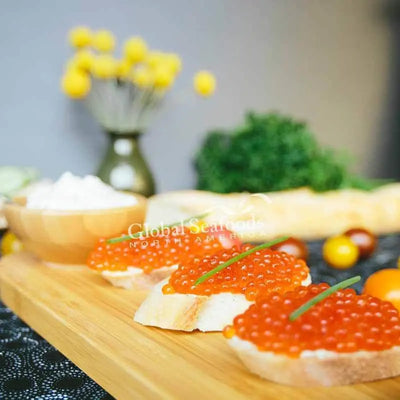
- Blini with crème fraîche: Warm (not hot) blinis, crème fraîche, caviar added last. The definitive Russian-style presentation.
- Sushi and sashimi: Ikura gunkan-maki (battleship sushi — nori collar around sushi rice, generously filled with ikura) or as a nigiri topping. Added at room temperature directly from refrigerator.
- Toast points or dark rye: Lightly buttered, cooled, caviar last.
Modern applications:
- Deviled eggs: Pipe egg mixture, rest to room temperature or slightly warm, then add caviar on top before serving.
- Pasta with cream sauce: Plate the pasta, rest 30–60 seconds, add caviar on top with a non-metal spoon. Never stir caviar into hot sauce or add to the pan — heat destroys the texture and flavor.
- Avocado toast / tartines: Assemble at room temperature; caviar last.
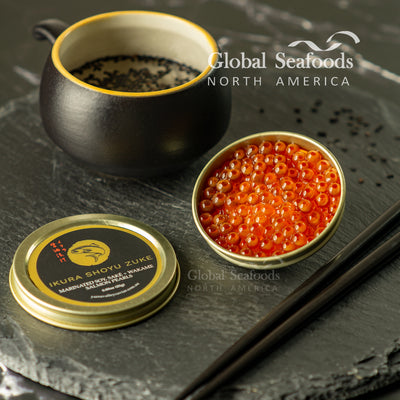
- Ikuradon: Seasoned sushi rice (room temperature, not hot), shoyu-zuke ikura on top. For malossol ikura, add a small drizzle of dashi tare. Never over hot rice.
Soups: Ladle soup into bowl, allow to cool from boiling to warm (below 140°F / 60°C), then add caviar as a garnish on top. Do not add to a hot pot or freshly ladled boiling soup.
Temperature and tools: Serve directly from refrigerator temperature (32–38°F). Use mother-of-pearl, bone, wood, or food-safe plastic spoons exclusively. For table service, present the caviar tin on a bed of crushed ice (tin on ice, not caviar directly on ice).
Recipe videos: Global Seafoods YouTube Channel.
Sourcing Quality Salmon Caviar
What to look for: wild-caught Alaskan origin (NPFMC/ADF&G quota management, male-only harvest for salmon where applicable, escapement-based management); malossol cure (3–5% salt); MSC certification where available; pack date visible on the label (not just expiration date); glass jar or lacquered tin (not bare metal container).
Browse: Red Caviar Collection | Salmon Caviar Collection.
Frequently Asked Questions
How long does salmon caviar last after opening?
Malossol salmon caviar: consume within 2–3 days of opening, stored at 32–38°F (0–3°C) in an airtight container. Shoyu-zuke ikura: 1–2 days after opening. Always use a non-metal spoon and reseal tightly after each use to minimize air exposure.
Is salmon caviar good for weight management?
Yes — approximately 40–50 calories per 30g (1 oz) serving, ~6–8g complete protein, and effectively zero carbohydrates. The high protein-to-calorie ratio supports satiety. Sodium content (~300–500mg per 30g) is relevant for those on sodium-restricted diets; adjust serving size accordingly.
Can children eat salmon caviar?
Salmon roe is nutritionally beneficial for children — DHA (an omega-3 in phospholipid form) supports normal brain and eye development. However, a few considerations apply: sodium content is relatively high (300–500mg per 30g), so portion size matters for young children; fish allergy should be ruled out before introduction; and unpasteurized malossol caviar is a raw fish product, so consult a pediatrician for infants and toddlers. For older children without fish allergies, salmon roe is an excellent nutrient-dense food.
Why does salmon caviar have a popping texture?
The egg is surrounded by a thin, flexible membrane (the vitelline membrane and zona radiata). When intact and properly stored at cold temperatures, this membrane is elastic and firm. When bitten, it yields suddenly and bursts, releasing the liquid contents inside. Over-ripe, improperly stored, or previously frozen (and thawed) roe has a weakened membrane that breaks without the characteristic burst, producing a mushy texture instead.
Is all salmon caviar the same?
No — species, season, cure method, and quality grade all produce significant differences. Chum ikura (largest, mildest, most vibrant orange, Japanese premium standard) differs substantially from pink salmon roe (smallest, palest, lightest flavor, most affordable) and from Coho (mid-size, tangy, versatile). Malossol and shoyu-zuke cures produce different flavor profiles from the same roe. Quality grade (membrane integrity, size uniformity, color consistency) also varies significantly between producers.
Where can I buy the highest-quality salmon caviar?
Global Seafoods Red Caviar Collection — sustainably sourced Alaskan wild-caught salmon roe across multiple species and cure styles, with fast cold-chain shipping.
Related Products


Also in News

Snail Caviar: How White Escargot Caviar Is Farmed, Harvested and Made

The Dark Years of Pacific Salmon: A 20-Year Outlook for Alaska, Russia, and the Red Caviar Market

King Crab Legs Delivery: Is It Worth It? Exploring the Benefits and Best Options
Shop Now
Main
