
Osetra Caviar Trivia: 10 Fun Facts About the King of Caviar

10 Facts About Ossetra Caviar Worth Knowing
Ossetra caviar is one of the most discussed varieties in the premium caviar category, but a lot of what circulates about it is marketing copy rather than fact. Here are 10 specific, verifiable facts about Ossetra — its biology, history, production, flavor, and what distinguishes it from other varieties.
Fact 1: The name refers to the species, not a grade. "Ossetra" (also spelled "Osetra") is a transliteration of the Russian word осётр (osetr), meaning sturgeon. It specifically refers to caviar from Acipenser gueldenstaedtii (Russian sturgeon) and sometimes Acipenser persicus (Persian sturgeon). It is a species designation, not a quality grade. A retailer selling "Grade 1 Ossetra" and "Grade 2 Ossetra" is grading within the species — both are genuine Ossetra.
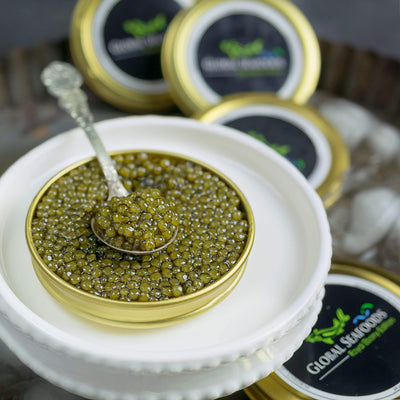
Fact 2: Its color range is unusually wide. Ossetra pearls range from jet black through dark brown to golden-amber — a wider natural color spectrum than any other commonly traded caviar variety. The color correlates with the fish's age, diet, and fat content, not with quality rank. Golden-grade Ossetra from older females is lighter, lower in salt, and more complex in flavor; but a dark standard-grade from a younger fish is equally authentic Ossetra.
Fact 3: Golden-grade Ossetra is among the most analytically complex caviars available. Premium golden Ossetra from mature females (≥10 years) contains a higher proportion of unsaturated fatty acids, a lower salt-to-fat ratio, and a more complex volatile organic compound profile than younger fish. This is the biochemical basis for its longer finish and more nuanced flavor. It is not marketing; the flavor difference between standard and golden Ossetra from the same producer is measurable and consistent.
Fact 4: A. gueldenstaedtii females reach egg-bearing maturity in 7–12 years under farm conditions. This is significantly faster than Kaluga or Beluga (*Huso huso*, 18–25 years in the wild) but slower than Siberian (*A. baerii*, 5–8 years). The maturity timeline is the primary driver of Ossetra's price premium over Siberian: more years of farm input per harvest cycle.
Fact 5: The hazelnut comparison is real, not just a description convention. The nutty flavor in high-quality Ossetra correlates with specific volatile compounds — including pyrazines and lactones — found in the fatty acid profile of the eggs. These same compound families are responsible for roasted nut aromas. The comparison to hazelnut or walnut in Ossetra tasting notes is a genuine perceptual alignment, not just evocative language.
Fact 6: Wild Caspian Ossetra is no longer commercially available at meaningful volumes. A. gueldenstaedtii is classified as Critically Endangered by the IUCN. Commercial wild sturgeon fishing in the Caspian was subject to increasingly strict CITES quotas from the 1990s onward and effectively ceased as a commercial category by the early 2000s. All Ossetra sold through reputable US retailers today is farmed.
Fact 7: China is currently the world's largest producer of farmed Ossetra. Operations including Kaluga Queen in Heilongjiang Province produce large volumes of A. gueldenstaedtii caviar that is exported globally under internationally recognized quality standards. Italian, French, and Israeli producers also produce premium Ossetra at lower volumes and higher price points. US-domestic Ossetra production is limited.
Fact 8: Ossetra roe represents approximately 8–15% of the female's body weight at harvest. A mature female A. gueldenstaedtii weighing 15–20 kg may yield 1.2–3 kg of roe. After processing loss (membrane removal, washing, salt absorption), the final packed weight is lower. This yield-to-body-weight ratio is similar to Siberian and better than Kaluga or Beluga, which contributes to Ossetra's slightly lower price per gram than Kaluga at comparable quality grades.
Fact 9: The "Ossetra vs. Beluga" comparison most buyers encounter is not comparing equivalent products. The "Beluga" commonly sold in the US is Kaluga hybrid (Huso dauricus × Acipenser schrenckii) — genuine wild Huso huso beluga has been banned from US import since 2005. When US retailers position Ossetra against "Beluga," they are comparing A. gueldenstaedtii against a Kaluga hybrid, not against true Caspian beluga. Both are excellent products; buyers should know what they are actually comparing.
Fact 10: Ossetra is the variety most often recommended by experienced tasters as the best introduction to premium caviar. While Kaluga hybrid is milder and more immediately approachable, and Sevruga is bolder, Ossetra's midpoint position — moderate brine, complex flavor, medium bead, firm pop — gives a first-time buyer the widest range of information about what high-end caviar tastes like. A single Ossetra tasting covers more of the flavor dimension spectrum than any single variety at either extreme.
Ossetra quick reference
Species: Acipenser gueldenstaedtii (and A. persicus). Bead size: 2–3mm. Color: Dark gray to golden-amber. Flavor: Nutty, complex, moderate brine, mineral finish. Farm maturity: 7–12 years. Shelf life (fresh malossol, unopened): 4–6 weeks at 28–32°F. After opening: 48–72 hours with plastic wrap pressed directly onto eggs. Best pairing: Dry Champagne, vodka, or Junmai Daiginjo sake. Spoon: Mother-of-pearl, bone, horn, or plastic/resin only — no metal.
Order: Ossetra Sturgeon Caviar. Compare varieties: Caviar Collection. Video guides: Global Seafoods YouTube Channel.
Related Products


Also in News

Snail Caviar: How White Escargot Caviar Is Farmed, Harvested and Made

The Dark Years of Pacific Salmon: A 20-Year Outlook for Alaska, Russia, and the Red Caviar Market

King Crab Legs Delivery: Is It Worth It? Exploring the Benefits and Best Options
Shop Now
Main
