
Exploring the Exquisite World of Caviar Restaurants

Exploring the Exquisite World of Caviar Restaurants
Caviar — the cured roe of sturgeon — is the benchmark luxury ingredient in fine dining: briny, buttery, and intensely flavored, with a texture and complexity that no other ingredient replicates. The finest restaurants in the world have built entire tasting menus around it. This guide covers the major caviar varieties served at top caviar restaurants, what makes those dining experiences exceptional, how to recreate a tasting at home, and where to source premium caviar for your own table.
Mercury: Sturgeon caviar is FDA "Good Choices" — safe to eat 2–3 servings per week. Source: FDA Advice About Eating Fish.
Products: Kaluga Caviar • Ossetra Sturgeon Caviar • Beluga-Style Caviar • Siberian Sturgeon Caviar • California White Sturgeon Caviar • Sevruga Sturgeon Caviar.
Caviar varieties: what top restaurants serve
Beluga-style caviar (Kaluga hybrid) — the largest bead, richest flavor: True wild Beluga caviar from Caspian and Black Sea Huso huso has been banned from US import since 2005 by the US Fish & Wildlife Service due to the species' endangered status (CITES Appendix II; import permits are effectively unavailable for commercial trade in the US). What is legally sold in the US as Beluga-style or Beluga-hybrid caviar is Kaluga hybrid (Huso dauricus × Acipenser schrenckii), a farm-raised product that replicates the large bead size and rich, creamy, mildly briny flavor profile of wild Beluga. This is the product legally and correctly sold as Beluga-style in the American market.
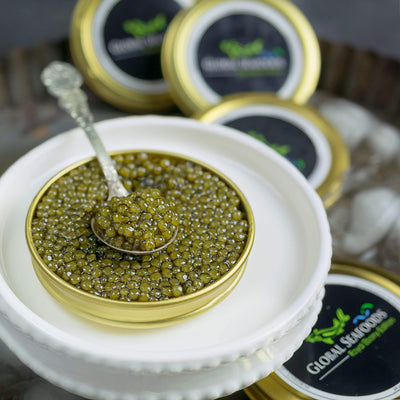
Ossetra caviar (Acipenser gueldenstaedtii) — nutty, complex, golden-brown to dark: Ossetra (also spelled Osetra or Osetr) is widely considered the most complex-flavored commercially available sturgeon caviar — a distinctive nutty, almost hazelnut quality combined with brininess and a long finish. Bead size is medium; color ranges from golden-brown to dark gray-green depending on the individual fish's diet and age. Ossetra is the benchmark for connoisseurs who prioritize flavor complexity over bead size. Farm-raised Ossetra from Israel, Italy, France, and China is widely available and of high quality.
Kaluga caviar (Huso dauricus) — "River Beluga," large bead, buttery: Kaluga is a large Amur River sturgeon closely related to Huso huso (Beluga) and shares its large bead size and buttery, clean, mild flavor. Farm-raised Kaluga from China is the most widely available large-bead sturgeon caviar legally sold in the US. Kaluga hybrid (Kaluga × Amur Ossetra cross) is the dominant Beluga-style product in the American market.
Sevruga caviar (Acipenser stellatus) — smallest bead, boldest flavor: Sevruga has the smallest bead of the classic Caspian trio and the most intensely briny, assertive flavor. Wild Sevruga harvest is severely restricted under CITES; most commercial Sevruga sold today is farmed. Its bold flavor profile makes it a favorite among caviar purists who prefer intensity over subtlety.
Siberian Sturgeon caviar (Acipenser baerii) — accessible, well-rounded: Siberian Sturgeon is the most widely farmed sturgeon globally due to its fast growth rate and adaptability. The caviar is clean, moderately briny, with a pleasant earthiness — an excellent entry-level sturgeon caviar and frequently found on restaurant tasting menus as an accessible reference point.
California White Sturgeon caviar (Acipenser transmontanus) — domestic, sustainable: White Sturgeon is the largest North American sturgeon species and is farmed sustainably in California (Sacramento/San Joaquin delta region). The caviar is mild, buttery, and clean — comparable to mid-tier Ossetra in flavor profile. An important domestic product for US consumers who prioritize locally farmed, traceable sourcing.
Top caviar restaurants
Petrossian Restaurant and Boutique (New York City and Paris): The Petrossian brand has been synonymous with caviar importing and dining since 1920 (founded by the Petrossian brothers in Paris as importers of Caspian caviar to France). The New York location offers caviar flights, tasting menus, and retail. Specialties include Ossetra, classic accompaniments (blinis, crème fraîche, toast points), and champagne pairings. Price range: approximately $150–$300+ per person; check current menus for pricing.
Caviar House and Prunier (London and Zurich): One of Europe’s oldest premium caviar brands (Prunier origins trace to 1872 as a Paris seafood brasserie; Caviar House is the modern retail/restaurant entity). Specialties include Beluga-style and Ossetra caviars alongside gourmet seafood dishes and champagne pairings. Price range: approximately $200–$400+ per person; check current menus.
Caviar Russe (New York City): A Manhattan caviar-focused restaurant and boutique that has held Michelin recognition (star status varies by year; check current Michelin listings). Specialties include Golden Kaluga, chef’s caviar tasting menus, and champagne service. Price range: approximately $250–$500+ per person; check current menus.
How to host a caviar tasting at home
A home caviar tasting requires only a few well-sourced varieties, the correct serving equipment, and appropriate accompaniments. The goal is a structured tasting that lets guests experience how different species, grades, and origins produce distinctly different flavor profiles.
Variety selection: For a comparative tasting, choose 2–3 contrasting varieties — for example: Siberian Sturgeon (mild, earthy reference point) + Ossetra (nutty, complex) + Kaluga hybrid (large bead, rich, buttery). This covers the main flavor and texture dimensions of sturgeon caviar. For budget-friendliness, include California White Sturgeon as a domestic option alongside one premium imported variety.
Quantity: For a tasting (not a main course), 10–15g (approximately ½ oz) per variety per person is appropriate. For a generous standalone appetizer, 28–30g (1 oz) per person per variety.
Serving equipment: Always use non-metallic spoons — mother-of-pearl (traditional), bone, or food-grade plastic. Metal reacts with caviar’s amino acids and imparts a metallic off-flavor on contact. Present each variety in a small glass or ceramic bowl nested in crushed ice to maintain serving temperature below 40°F / 4°C.
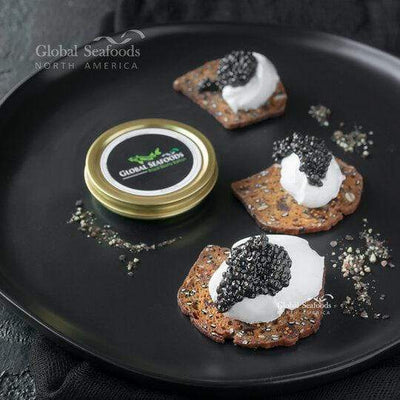
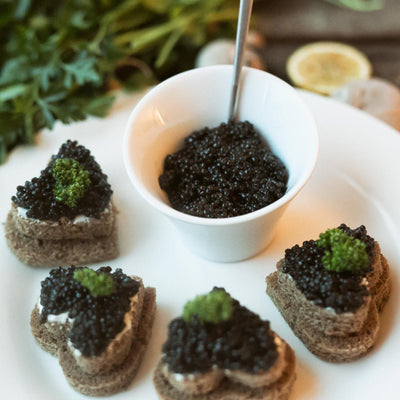
Accompaniments: Blinis (small buckwheat or plain pancakes), toast points, or unsalted crackers; crème fraîche or sour cream; fresh dill; thinly sliced chive; lemon wedges. Serve accompaniments separately — let guests build their own bite so the caviar flavor is not masked by the base.
Beverages: Ice-cold vodka (the classic Russian pairing — neutral spirit that does not compete with caviar’s briny complexity); Blanc de Blancs Champagne or Crémant (fine bubbles and high acidity complement brininess); dry Albarino. Avoid tannic reds, heavily oaked whites, or sweet wines — all conflict with caviar’s salt and umami.
Products: Wild Sturgeon Black Caviar • Russian Ossetra Caviar.
Videos and recipes: Global Seafoods YouTube Channel.
Related Products


Also in News

Snail Caviar: How White Escargot Caviar Is Farmed, Harvested and Made

The Dark Years of Pacific Salmon: A 20-Year Outlook for Alaska, Russia, and the Red Caviar Market

King Crab Legs Delivery: Is It Worth It? Exploring the Benefits and Best Options
Shop Now
Main
