
Exploring the Best Caviar Restaurants and Bars in Las Vegas

Exploring the Best Caviar Restaurants and Bars in Las Vegas
Las Vegas has built one of the most concentrated collections of fine dining in the world, and caviar service is a natural extension of that ethos. The city’s top hotels and restaurants maintain dedicated caviar programs — purpose-selected caviar varieties, trained service staff, traditional accompaniments, and serious champagne and vodka programs — at a level that rivals the best caviar bars in New York, Paris, or Tokyo. This guide covers the key venues, what to order, and how to bring the same experience home.
Note: Restaurant details (menus, prices, phone numbers, hours) change. Verify directly with each venue before visiting. Price ranges and Michelin designations reflect available information at time of writing and may not be current.
Caviar Varieties to Know
Understanding what you’re ordering elevates the experience significantly.
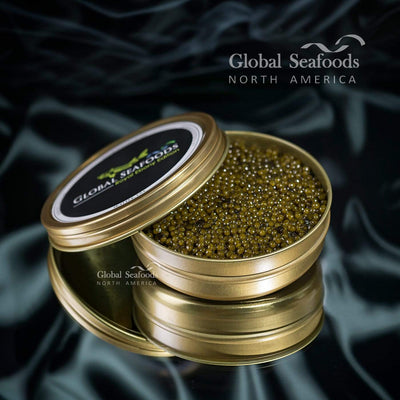
Kaluga Hybrid Caviar (“River Beluga”): Produced from Kaluga x Amur sturgeon hybrids farmed in controlled freshwater environments. Large, glossy pearls with a creamy, buttery flavor and clean finish. Because true Beluga (Huso huso) caviar has been banned from import into the United States since 2005 by the US Fish & Wildlife Service (due to endangered species status), Kaluga hybrid is the closest legal equivalent and what “Beluga-style” caviar in the US refers to. Available at Global Seafoods.
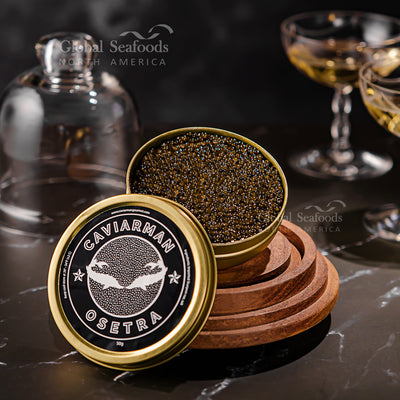
Ossetra Caviar (Acipenser gueldenstaedtii): Medium-sized pearls ranging from golden to dark brown; complex, nutty flavor with pronounced umami. One of the most respected varieties among connoisseurs. Available at Global Seafoods.
Sevruga Caviar (Acipenser stellatus): Small, fine-grained pearls with an intensely briny, assertive flavor. Listed on CITES Appendix II; import and sale is subject to strict regulation. Verify sourcing and import compliance when ordering.
Siberian Sturgeon Caviar (Acipenser baerii): Farmed widely and legally; dark, firm pearls with a clean, earthy flavor. A well-priced entry point into quality sturgeon caviar. Available at Global Seafoods.
White Sturgeon Caviar (Acipenser transmontanus): American farmed; firm, dark pearls with a mild, clean oceanic flavor. Fully legal, sustainably farmed in California. Available at Global Seafoods.
Paddlefish Caviar: American-sourced; small, dark pearls with a mild, slightly earthy flavor. An accessible and legal domestic option. Available at Global Seafoods.
Top Caviar Venues in Las Vegas
Verify current status, menus, and hours directly with each venue before visiting. Details below reflect information available at time of writing.
Petrossian Bar at Bellagio
One of Las Vegas’ most enduring caviar destinations, located in the Bellagio Hotel. Petrossian is a Paris-founded house with over 90 years of caviar heritage; the Las Vegas bar carries their signature Ossetra and Kaluga selections served with traditional accompaniments: blinis, creme fraîche, chopped egg, and minced onion. Paired with Champagne or premium vodka. Price range approximately $150–$500 per serving (verify current pricing). Address: 3600 S Las Vegas Blvd, Las Vegas, NV 89109. Phone: (702) 693-7111.
Caviar Russe at Resorts World Las Vegas
Caviar Russe is a New York-based caviar institution that brought its tasting menu format to Resorts World. The format centers on multi-course caviar progressions with wine pairings, focused on sustainably farmed Kaluga and Siberian sturgeon. Michelin recognition (verify current status). Price range approximately $200–$600 per tasting. Address: 3000 S Las Vegas Blvd, Las Vegas, NV 89109. Phone: (702) 676-7000.
SW Steakhouse at Wynn Las Vegas
Primarily a premium steak and seafood restaurant, SW Steakhouse maintains a curated caviar selection as part of its luxury seafood offerings — typically Ossetra and other farmed sturgeon varieties with house-made accompaniments. Price range approximately $120–$400 per serving. Address: 3131 Las Vegas Blvd S, Las Vegas, NV 89109. Phone: (702) 770-3325.
Caviar Pairings: What Works and Why
Champagne: The traditional pairing. The effervescence scrubs the palate between bites; the acidity and mineral notes of a Blanc de Blancs or vintage Champagne complement rather than compete with the caviar’s brine. Avoid heavily oaked or sweet Champagne — both muddy the caviar’s delicate flavor. A crisp Chablis or unoaked white Burgundy works on the same principle for a still wine option.
Vodka: The Russian and Eastern European tradition. Serve well-chilled, neat — never mixed. Premium unflavored vodka (no aromatic additions) is the correct call; the spirit’s neutral clean finish resets the palate without adding competing flavors. Grain-based vodkas are generally preferred over potato-based for this pairing.
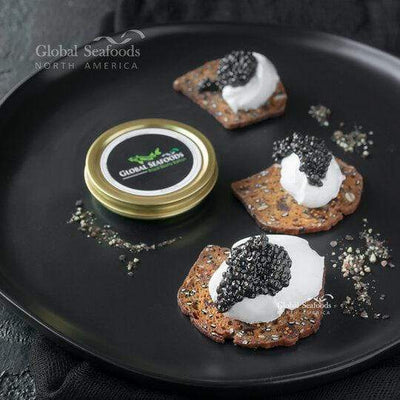
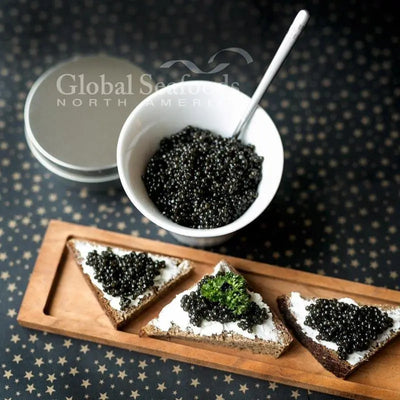
Traditional accompaniments: Blinis (small buckwheat pancakes — the slight earthiness of buckwheat complements the caviar’s brine); creme fraîche (fat content carries the flavor; sour cream is an acceptable substitute); finely chopped hard-boiled egg white and yolk served separately; minced white onion (use sparingly — it can overpower). Avoid acidic or strongly flavored accompaniments that compete with the caviar.
What not to pair: Citrus directly on caviar (the acid chemically alters the protein and can make the pearls taste metallic); metal spoons (the oxidation from silver or stainless steel reacts with the caviar’s compounds and imparts a metallic off-flavor); strongly flavored crackers or bread (use plain, unsalted blinis, toast points, or neutral crackers).
Hosting a Caviar Night at Home
The Las Vegas experience is reproducible at home with the right sourcing and a few non-negotiable details.
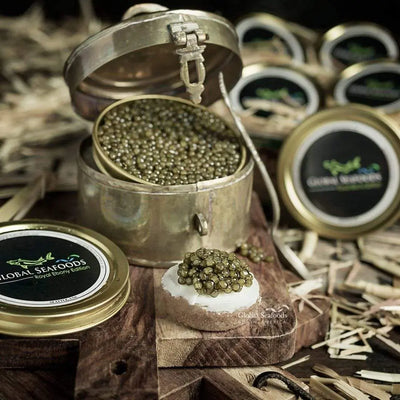
Select the caviar: Order from a verified supplier. For a tasting format, choose two or three varieties at different price points — a good progression is White Sturgeon or Paddlefish (entry), Siberian Sturgeon (mid), and Kaluga Hybrid or Ossetra (premium). Serve in the order of mildest to most intense flavor. Premium options from Global Seafoods: Kaluga Caviar, Ossetra Caviar, Siberian Sturgeon Caviar.
Serve correctly: Keep caviar nested on ice — serve in the tin on a bed of crushed ice or in a chilled serving bowl set over ice. Optimal serving temperature is 28–32°F (−2 to 0°C). Use mother-of-pearl, bone, or ceramic spoons exclusively — never silver or stainless steel. Serve in small portions (7–14g per person as a tasting amount; 30g per person for a more generous service).
Timing: Remove caviar from the refrigerator 5–10 minutes before serving to allow the flavor to open slightly — caviar served straight from the refrigerator can taste muted. Do not leave out longer than 20–30 minutes once opened.
Champagne or vodka: Chill both well in advance. For Champagne, target serving temperature of 45–48°F (7–9°C). For vodka, serve as cold as possible — keep in the freezer.
Frequently Asked Questions
Is Beluga caviar available in Las Vegas restaurants?
Not legally, if it is true Beluga (Huso huso). The US Fish & Wildlife Service banned import of Beluga caviar from the Caspian and Black Sea in 2005 due to the species’ endangered status. What Las Vegas restaurants serve as “Beluga-style” or “Beluga” caviar is Kaluga hybrid (Huso dauricus x Acipenser schrenckii), which produces a comparable large-pearl, creamy-buttery flavor profile and is legally farmed and sold in the US.
What is the correct way to eat caviar?
Place a small amount (a half-teaspoon or so) on the back of your hand between thumb and forefinger, or directly on a blini with a pearl spoon. Allow it to warm slightly on the palate before the pearls burst — chewing immediately releases the flavor but bypasses the textural experience. The traditional back-of-hand method warms the caviar to body temperature and lets the flavor develop before eating. Take small sips of Champagne or cold vodka between tastings to reset the palate.
Why use mother-of-pearl spoons?
Metal utensils (silver, stainless steel, gold) contain trace compounds that react with the amino acids and fatty acids in caviar, imparting a metallic or off-flavor that is particularly noticeable in delicate varieties like Ossetra. Mother-of-pearl, bone, and ceramic are inert and do not alter the flavor. This is not a matter of tradition alone — it is detectable in a side-by-side comparison.
How much caviar per person for a tasting at home?
7–14g (1/4–1/2 oz) per person per variety for a proper tasting — enough to experience the flavor and texture across 3–4 servings without palate fatigue. For caviar as a main event (not a tasting), 30–50g (1–1.75 oz) per person is the standard service size at fine dining venues. Order accordingly and account for the fact that the tin should be consumed within 2–3 days of opening.
Can I order premium caviar online for a home event?
Yes — ordering online from a reputable supplier with proper cold-chain shipping is the standard approach for home caviar events. Global Seafoods ships caviar with proper temperature control. Order to arrive 1–2 days before your event; do not open until day-of service.
What is the difference between farmed and wild caviar?
Most caviar available in the US today is farmed — this is not a quality compromise. The best-regarded caviars (Kaluga hybrid, Ossetra, White Sturgeon) are all farmed in controlled environments, which allows for consistent feed, water quality, and harvest timing. Wild sturgeon populations in the Caspian and Black Seas are critically endangered; US import restrictions effectively mean wild-source Caspian caviar is not legally sold here. Farmed caviar from reputable producers can equal or exceed wild caviar in quality and is the ethically and legally sound choice.
Related Products


Order Paddlefish Caviar Online – Premium, Sustainably Sourced Caviar Delivered to Your Door
View Product
Also in News

Snail Caviar: How White Escargot Caviar Is Farmed, Harvested and Made

The Dark Years of Pacific Salmon: A 20-Year Outlook for Alaska, Russia, and the Red Caviar Market

King Crab Legs Delivery: Is It Worth It? Exploring the Benefits and Best Options
Shop Now
Main
